Showing posts with label social studies. Show all posts

Friday, May 18, 2018

Making Converts

For several weeks it felt like spring would never happen. It was cold and dreary. We were having snow days in April and the year kept getting longer. Finally, the sun came out, the air warmed, and it started to feel like the year was winding down. There was prom. Now the seniors are leaving for internship. The exam schedule has been published. And that is either coinciding with or maybe causing a shift in the thinking of a few of my colleagues. This is what I am hearing:

- They need to do project.

- The seniors should do something fun before they go.

- They are checking out; I need a way to hook them back in.

And, then, a couple of them asked: can you explain that makerspace to me again?

Of course! YES! I would love to! And then I put some pipe cleaners in their hand while we talk.

This week I have been working with a Social Studies teacher in two of her classes and with an English teacher colleague in two of her classes - both pairs of classes are a mixture of juniors and seniors.

Today was the project due date for the Social Studies classes and here is how the teacher described what happened:

"We had a board game day today and the class broke into groups to play each of the games. And I did what you said, I told everyone they couldn't play their own game because one test of the effectiveness of the game was whether or not someone could follow the directions and understand how to play without them there to explain it all. And they didn't want to leave their games! They were so proud of them, they wanted to be sure that everyone else really appreciated and understood them." And then she added, "Remember that kid I told you about who still owes me so much work from last quarter? The one who never does any of the assignments? He made the coolest board game! He refused to leave his game. Flat out refused. And I let him stay so he could have that pride in what he had done."


That's when I told her a story about a group of girls in her class who had worked together on their project. They did all of their work in the classroom until the very last project work day. On that day my colleague, their teacher, was out. To get away from the sub, the students decided to work in The Garage (our makerspace). When they arrived they asked me, "what are we supposed to do?" I put pipe cleaners in their hands and replied "Well, what do you need?" They said they needed a spinner and playing pieces. So I asked: "Well, what should the pieces look like or represent?"

You know where this is going... those pipe cleaners were quickly bent into a prototype of the animal shapes they needed. I directed them to our bins of supplies and recyclables and they looked at me with open mouths; "Has this been here all year?!" they asked. I nodded. They grabbed each others arms and exclaimed: "Can we come here during a free and just make stuff?" I told them, "Of, course!" To which they responded: "This makes me so happy!"

I couldn't join their class for project sharing day because my English colleague brought her classes to The Garage for their first full-period making session. This project is the culmination of their study of Jeanette Walls, The Glass Castle. Last week, I introduced the project to them with this discussion of unattainable dreams, symbols, and the relationship between artists and their audience.

Less than a minute into class she leaned over and said, "Oh! This is amazing. I am so glad you are getting pictures of this! Should I take some, too?" Here is what was so amazing. Complete and total engagement in selecting the only required element of their project: a piece of glass. The students were sharing and comparing. Discussing the merits of clear vs. translucent glass. Shape and texture were important, too. Then I delivered a 3-minute orientation to the space, listing a variety of materials from pom poms to old "steampunk" hardware and ended with: "If you are thinking about a material you can't find, just ask." That's it. They were off!

Once they had been planning, designing, and experimenting for about 10 minutes, I approached a small
group who were intently debating the best way to attach two parts of a project. I asked what problem they were trying to solve and they showed me and launched into an explanation of the merits of the different solutions they were entertaining. Their English teacher approached and looked over my shoulder, and the students entirely shifted gears. "Don't worry, don't worry!" they said. "It's going to be good. You're gonna like it. There is a good reason for what we are doing. I promise: we are working."

My colleague pulled me away from them and asked, "Did you see that? Did you see what just happened? As soon as I walked over it became all about the grade, about reassuring me they were making something I would like. This is entirely different than when you come to our classroom. Our roles here are totally different. But they are thinking so intently and in such different ways. I mean, look at them! Some of these kids checked out weeks ago and now they are so engaged I can't even talk to them!"


The best observation came next:

"You need to come to one of our department meetings at the very beginning of the year next year and tell everyone about this. And then people like me will back you up. I know you told us about it at a meeting earlier this year, but we didn't get it. But now there are more of us to help people get it."

I will gratefully accept an opportunity to discuss making with them. And, next time, I will bring pipe cleaners!

Monday, April 23, 2018

Living Tableaux: kinesthetic lessons in empathy and digital citizenship

Whether you are a library media specialist, a teacher of social studies or art history or ELA or any other discipline that incorporates art and photography as a teaching tool or element of content, building living tableaux -- people posing to replicate a 2D image -- is a classroom exercise that has so many learning benefits for students! It is a kinesthetic experience that challenges students to develop empathy with the figures being depicted and even fosters conversations about digital citizenship.

Kinesthetic
To form a tableau, I allow students time to scan the painting, then ask them to choose a person on whom they want to focus. Alternately, you can group the students and assign each group one character from the painting to consider. Then I ask students to stare at just that person and to think and wonder about that person while looking at him/her. I give them a moment to jot down what thoughts, feelings, and questions they have before moving to the next step. For this exercise, let’s imagine that we are studying Experiment on a Bird in the Air Pump by Joseph Wright.

Once students have collected their thoughts, I ask for a student from each group to volunteer to become the person s/he scrutinized from the painting. These students then assemble themselves in the middle of the classroom in a re-creation of the painting. Once they are set, the rest of the class can adjust “the posers” by re-positioning them for accuracy, directing their body language and facial expressions. They may apply props from the classroom to enhance the living replication of the original. 

Empathetic
Students will have to break the tableau to participate in the discussion so, if possible, take a picture of the students in their arrangement and post it for them to see alongside the image of the original work. When analyzing and discussing paintings, I always remind my students that every element of a painting is the conscious choice of the artist. Even happy accidents that remain in the final work do so because the artist decided they should stay. Every color, brushstroke, facial expression, object is there by choice and design. Therefore, as viewers of the painting, in order to fully engage in the artist’s message, purpose or intent, we must ask “Why?”

Before discussing, I ask students to engage in some reflective writing. I give them a few minutes to collect their thoughts about what their person: thinks, feels, wonders, fears, hopes, sees, believes. I prompt students to consider gender and gender identity, age, attire, body language, facial expression, relationship to the group, etc. as they collect their thoughts. Before we discuss the painting as a class, the students share these reflections with their small group.

I transition to whole class discussion by asking those students who posed in the tableau to share how it felt to be the person? What were they thinking about as they held the facial expression and posture of their person?

Then, I ask other students to share their observations of the person they examined. Once they have explored the figures individually, I prompt them to consider the relationships between the people in the painting and finally, I ask what they think this painting is about. For an artwork like Joseph Wright’s Experiment on a Bird in the Air Pump, I prompt them to push past the literal… it is a painting about an experiment (which it is), because it is also a painting of risk-taking, of questioning or inquiry, of seeking answers, of fear. In fact, I have used this painting as an introduction to a unit on the Enlightenment and students have come to the conclusion that this is a painting of the moment of becoming Enlightened. At that point, I draw their attention the man in red. Why is he (and the bird) the only person looking at us, the viewer? What is our role in the experiment? Why did the artist make us complicit in the secret proceedings?

Once you know something, you can never un-know it. Once people start to question and seek answers and learn new realities, the world can never be the same. Welcome to the Enlightenment!

Citizenship
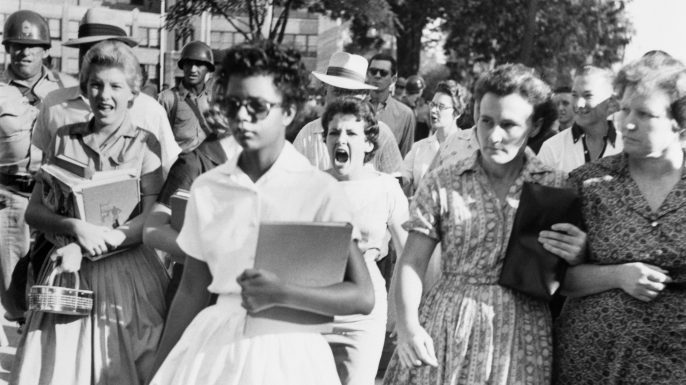
This exercise can be applied to a photo as well as a painting or other work of art. Consider photos that capture emotionally dramatic events like the iconic 1957 image of Elizabeth Eckford, pursued by Hazel Bryan, as she navigates the mob on her way to Central High School in Little Rock. Begin by selecting two students to reproduce the central figures, Eckford and Bryan. Then slowly add class members to the composition one at a time.

Ask students to closely consider the facial expressions of each person. What does the expression tell us about the emotions the person is experiencing in the moment this photograph was made? Push students to consider feelings beyond “mad” or “angry”. Ask them to consider what is motivating the emotions they think they see.

Ask students to discuss how well they think they think understand the people whose faces are not showing a lot of emotion. How can we understand people we can not visually read? Why are some people stoic and others agitated? How does someone maintain composure in such a circumstance?

Finally, ask students to consider who these people are today. Could they ever in their lives be recognized as anything other than who they were at this moment? No one in this photo posed for its making, yet the widespread and ongoing distribution of this photo has defined these people for generations. Ask the students: “How are you defining yourself and being defined by others in social media and other contexts?”

Big Takeaway
Visual texts in any media are powerful primary sources. Exercises like this equip students to examine and unpack these sources when they are doing independent research and help students build the reflective capacity for understanding their own image creation and distribution.

Thursday, April 19, 2018

How might we... engage in Gatsby?

I am preparing to embark on a new collaborations with a colleague in the English department. It will be a unit-long project-based exercise so we will work together for about four weeks. I have tested the methodology on a small scale with a social studies teacher while helping to introduce a project-based assessment. While extended collaboration between a library media specialist and a discipline teacher is not uncommon, in my experience it generally happens around research units, so it is exciting to be co-facilitating in a new capacity!

In English
For the English unit, the class will be reading The Great Gatsby. The teacher's literary priorities are for the students to explore:
  • private vs. public theme
  • unreliability of the narrator
  • the malleable nature of memory
  • conscious and unconscious creation of self
Because this is not an inter- or trans-disciplinary curriculum or course, the English teacher as invited a history teacher to direct a couple of lessons at the beginning of the unit to contextualize Fitzgerald and the novel.

With these teachers serving as the discipline or content experts, my role is to guide the students through the creation of a project in which they explore the intersection of the literary themes and history. In order to maximize student ownership of the project design, I am returning to the lessons of the Innovator Academy and introducing the students to  the "How might me...?" questions. This stem is the gateway to diverse and powerful ways of understanding and beginning to solve a problem. By viewing the communication of their insights as a problem to be solved, "how might we..." will push students to harness their strengths and talents as creators in order to tap into nuances of the text and its resonance across decades.

For example, there are so many possibilities for what a student could do in response to this question: "How might we expose the layers of self that Jay Gatz created?" This question could be asked in other ways such as, "How might we explain Jay Gatz’s compulsion to be someone else?" A student who chooses to turn his/her focus to the narration of the novel could ask: "How might we compensate for Nick’s unreliability as a narrator?" Students will have agency over the question that guides their inquiry and determines what they create.

Also important is that the question can be completed in so many ways for students to access any of the literary elements and rhetorical devices they will be studying. Consider these uses of "how might we..."
  • Amp up the good (Doesn’t Nick grow?)
  • Remove the bad (We are onto Nick, so it is OK)
  • Question assumptions (Who says he is unreliable?)
  • Use unexpected resources (Are there other characters offering their versions of events?)
  • Challenge the status quo (It’s not the narrator’s job to relate to us)
  • Address PoV (Would Jordan tell the story better? Which character barely speaks and how can we give him/her voice?)
  • Go after adjectives (like “unreliable;” maybe he is uninformed or naive?)
  • Play against the challenge (If Fitzgerald wanted us to compensate for Nick, he would have written a different narrator)
  • Explore opposites (How might we remove the need for a narrator?)
  • Employ analogies (Nick, as a narrator, is like, chocolate as a…)

Once each student chooses the How Might We problem s/he wants to pursue, we will provide brainstorming tools to help them explore the possible solutions. (Crazy 8’s is one example of a tool or protocol).

Students will partner with critical friends in the class and discuss the merits of each idea and choose the one they will prototype and ultimately create.

In Social Studies
With the students in 9th grade World History, I introduced "How might we..." in a very different context. This is a class of 55 students divided into two sections. Each section must work as a unit for this project. Here are the questions the teacher has outlined for the students:
  • What is progress?  (craft a definition of what progress means for a society)
  • Examine the 14th-17th century in Western Europe and determine if (and if so how) the Renaissance and Protestant Reformation were a time of progress.
  • Conclusion:  Why does this matter?  What drives progress?  What keeps society from progressing, perfection of institutions or individual challenge of institutions?

The only other criteria is that they may not deliver an oral presentation. Each section must devise a way to convince the other section of their thesis without a formal debate or stand-and-deliver talk. That's where "How might we..." comes in.

I guided the students through an exercise to determine the best means of conveying their argument and evidence beginning with: how might we best convey our findings and conclusion without talking directly to the other group? Exploring this prompt required them to consider the scope of their findings and the various media they contain. It also necessitated understanding their audience and the mode or modes of delivery most likely to sustain their interest and be accessible to all of them.

Let's say that one group decided what is most important is for the other group hear the music, public debates, and other sounds happening during these centuries. They could produce a podcast or radio show. They could create a music video by quoting and re-contextualizing music and words of the era. Lots of possibilities if they start to think aurally.

Maybe the other group decided what is important is touch. You have to hold the artifacts in your hand to understand how they worked and why they matter. They will be very busy in The Garage (our makerspace) then!

Sight can be the students' default mode. In this instance maybe they will decide to curate a museum exhibit using Google Arts and Culture. Or create a virtual reality simulation using a our 360 degree camera to take a photo or video of a scene or scenes they create. Or a living scavenger hunt where they find class members dressed in period costumes. Given how image rich these centuries were, yet another possibility is that they might build a mosaic using many images to combine and form a dominant image which they can then annotate.

What's really exciting to me, is that these students are owning the means by which they explore the content and by which they convey their learning. When their creative thinking and varied skill sets and experiences combine for this exercise I am confident the results will be amazing.

More, soon...

Monday, December 19, 2016

Using Question Stems to Spark Inquiry

As I am working with students on research exercises I am working to find ways to help them with the development of their research questions. The scope of their research and the means by which they explore what they learn are all products of a well-crafted research question. I am observing that students can ask very narrow questions that begin with "what" and very broad questions that begin with "why." Without prompting, they get stuck here: too narrow or too broad. To help them expand their inquiry strategies I have begun using these question stems to push their thinking:

Which?  This stem helps you to collect information to make an informed choice. For example: Which Twentieth Century president did the most to promote civil rights?

How? When you seek to understand problems and perspectives, weigh options, and propose solutions, try starting your question with this stem. For example: How should we solve the problem of water pollution in Long Island Sound?

What if? Your question can change history! Use the knowledge you have to pose a hypothesis and consider options. For example: What if the Apollo 13 Astronauts had not survived?

Should?  A question can invite self or community examination. Using this stem, you can make a moral or practical decision based on evidence. For example: Should we clone humans?

Why? Understand and explain relationships to get to the essence of a complicated issue. For example: Why do people engage in human trafficking?

I like these stems because students can decide on the purpose of their inquiry and use the stem best suited to that end. They also are versatile and can be used in any discipline. What is really key, is they push students away from bias confirmation, from the tendency to ask questions to which they believe they already know the right answer. By using these stems and asking many questions about the same topic, they are pushed to think critically about the subject of their research and remain open to a range of evidence and perspectives before developing their thesis.

Here are examples of the stems being used all about the Civil War:

  • Which Civil War general was the best military strategist?
  • How did King Cotton affect the Confederacy’s waging of war?
  • What if General Lee had better intelligence at Gettysburg?
  • Should Confederate symbols be used in official state flags and logos today?
  • Why did Great Britain favor the South during the Civil War?

And here are literary examples focused on Shakespeare's plays:

  • Which of the characters in Henry IV has the most relevance for today’s politicians?
  • How does Hal’s ascension to the throne affect perceptions of his father’s coup?
  • What if Brutus had made the final funeral oration in Julius Caesar?
  • Should Hamlet have minded his own business?
  • Why does Shakespeare use so many references to the natural and unnatural in Macbeth?

I have used these this year with grade 11 students researching the relationship between socioeconomic class and opportunity in modern America. These stems helped the students focus their topics under the umbrella of the unit essential question.

Today I will use them with grade 10 students. Their essential question is "What should be America's response to the current refugee crisis?" Imagine the research possibilities with each of these stems: Which country has a fair, enforceable policy in this current refugee crisis? How does US response to Syrian refugees compare with US response to Holocaust / Bosnia / Vietnam refugees? What if the US reinstated quotas like those of the 1920s? Should the UN establish and monitor camps for the refugees? Why did the French respond to the Calais Jungle as they did? Using these question stems, the students can focus their research on the aspect of this issue that is most interesting to them, and the teacher can engage with the students about content that the student has chosen so the curricular experience is personalized. Ultimately the students will be writing Op-Ed pieces and they range of issues and perspectives considered will read to rich classroom discussion and mean the teacher is not reading twenty five identical papers. A win-win exercise!