Showing posts with label digital citizenship. Show all posts

Saturday, November 3, 2018

VR Big Takeaway? Empathy!

When I think about Google, I tend to really be focusing on Google for Education. Last year I learned about a different team, Google’s Trust & Safety group. First, I was struck by the seriousness with which Google considers the online conduct and interaction of all of its users. Consider the comments section in a YouTube video, the Trust & Safety group works on policies and technical mechanisms for trying to maintain civil and constructive dialogue within that platform. They may not use the term digital citizenship to describe their focus, yet, in essence, that is their mission: supporting positive and productive digital interaction, globally. And I thought just trying to do it in my school was a daunting mission!

Last year, the Trust & Safety group brought their work to schools in the form of a virtual reality anti-cyberbullying curriculum. Partnering with the media production group, Harmony Labs, researcher Dr. Dorothy Espelage, and others, the team unpacked some important research:
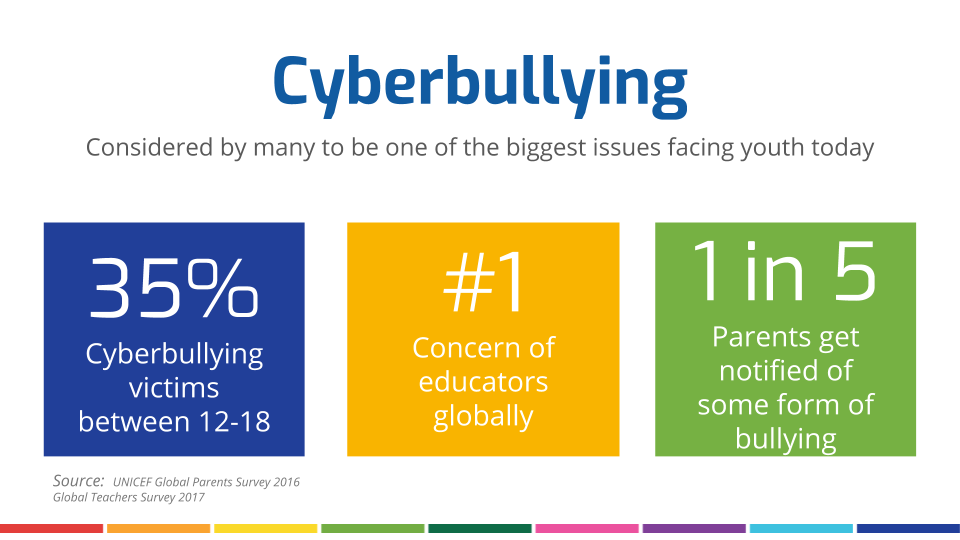

Furthermore, they learned that more than half of bullying incidents stop when a peer intervenes which lead them to the curricular objective of empowering bystanders to intervene in bullying situations. And, they chose virtual reality as the means of delivering the program they developed because VR provides a private, immersive experience. Participants do not have to be concerned about how they are being perceived by their peers which results in sincere and thoughtful engagement in the content.

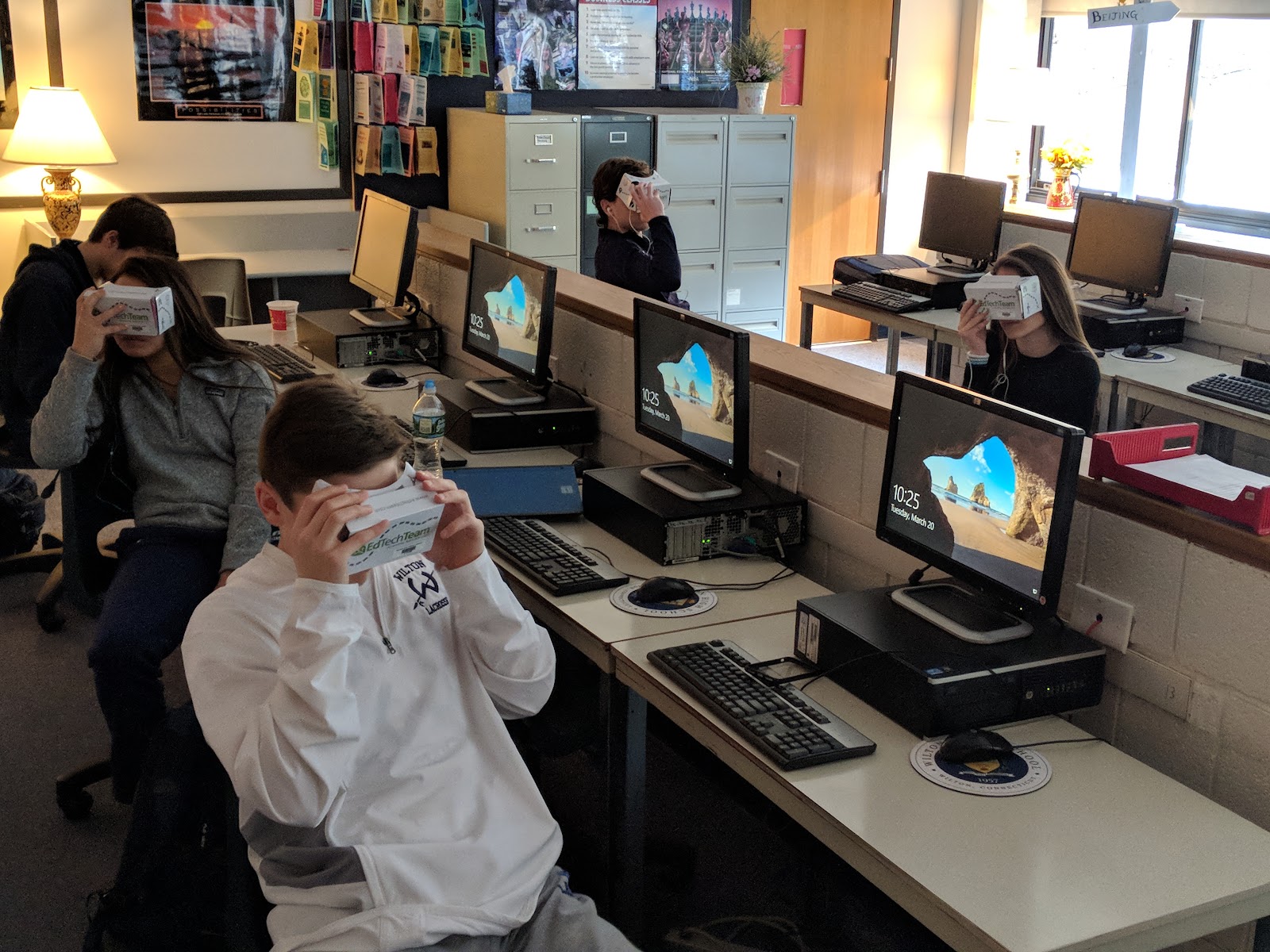
With that introduction to the program I jumped onboard with a class of ninth grade students. With a little advanced planning, implementation was easy! I do not have access to a class set of Daydream viewers and Pixel 2 devices so we substituted our Google cardboards and the students’ smartphones. I asked (and reminded) them to bring their own headphones so they each could listen to the videos without disturbing each other. The curriculum guide that Google provides is easy to follow with thorough teacher directions and talking points. I could easily modify it to meet the experience level of my students. Here is a quick schedule of what we did:

Day 1: I posted this Google Classroom announcement: For the next week you will need daily access to smartphone and headphones. Please let me know if you would like me to provide you a device. (For those students I had iPods in our library they could borrow). If you do not already have it, please install the YouTube app.

Day 2: I made this in class announcement and posted it as a Google Classroom reminder: please bring your phones and headphones to class tomorrow with the YouTube app already installed.

Day 3: The lessons began with a quick discussion of “what is virtual reality?” Then we followed the instructions in the curriculum guide for the first video lesson which included immersing in the 360° video experience. Students watched the 8 minute long video twice. The first time, the students watched on their own. The second time, I divided the class into three groups and assigned each group a character or group of characters on which to focus as they watched. Then we dove into a deeper conversation about the content.

Full disclosure: I was nervous. I was so concerned that this would just be one more forced conversation on a topic they didn’t want to discuss where a couple of students say what the teacher wants to hear just to get the lesson over with while the rest of the class stares into space and disengages entirely. Spoiler alert: the exact opposite is what happened, and I was amazed!

In small groups the students engaged with each other in a thoughtful discussion of what they had experienced, virtually. They discussed whether they thought the scenario was realistic, they considered the authenticity of the characters, they commented on identifying with certain characters based on their past experiences. When we reconvened as a whole class to talk some more they started to share experiences and talk to each other about how those real situations unfolded and what they could be doing about it. One student said, “It doesn’t end like that. We aren’t going to be friends in the end. We can’t be. When something like this happens, your friend group shifts. I want these programs to help us with that.” Lots of students added their agreement to that comment. Another student said, “Just like Kacie in the VR, sometimes you are bullied because of something you have done. And if I did what she did, and was bullied, I’m not going to tell an adult what I did so I’m not going to get help. I need someone else I can talk to for help.” Finally, another golden comment from a student: “I once did exactly what this told us to do: I told a safe adult and that person didn’t help me. So I’m not going to tell an adult again.”

Whoa. On the surface, this may sound like the experience missed the mark, but it didn’t at all. Look at all of the important information it exposed: Students want us to understand (empathize with) their experience so we can help them accurately. Students want and need peer support, so we need to train peers to help peers. And, students want us to be equipped to help them and many of us might need training to do that well.

Days 4 and 5: We continued with the two remaining VR experiences following the curriculum guide outline. Then I asked students to compare the VR lessons with other digital citizenship and bullying lessons they have experienced. They were in 100% agreement that this experience was different in a meaningful way. Here is how one student explained it: “We were there. I mean, you couldn’t avoid what was happening because we were in the scene. I had to admit what was happening was real.” When I pushed them to comment on why that mattered, another student said, “I felt bad about what was happening to someone so I wanted it to stop.” And that is the magic of this experience: it helps build empathy. VR is more than bells and whistles when it is used to quite literally help students walk in someone else’s shoes!

Days 6 and 7: I am fortunate to have a 360° camera so the final exercise for the students was to create their own VR video which we loaded to our library YouTube channel. Just as with the curricular videos, the student-created ones can be launched in the YouTube app and watched with a Google cardboard for an immersive experience. I gave students one day to examine how a 360° video is different from a traditional one and plan their script for a one minute video. The next day, five student groups each filmed their videos. This might be the fastest video project I have ever facilitated!

Day 8: We took out the cardboards, phones, and headphones one more time so they could watch each others videos and provide feedback. The students were able, in their own voices, to explore what cyberbullying looks and feels like in their own peer groups and begin the process of starting a conversation in our school.

Of course this curriculum is not a one-stop, surefire solution to a problem we all face in our schools and communities. It did start a conversation among my students that had more depth and buy-in than anything else I have experienced with students on this topic. And it all comes back to how the virtual reality helped them develop empathy.


Tuesday, October 30, 2018

Solving the Problems of Social Media, Part 1

This week we began a new unit in the Digital Literacy class that I am teaching; I called the unit, "Social: the new media". I curated a playlist of videos on YouTube for creating flipped lessons and giving students opportunities to explore sub-topics of interest to them. I consulted the lessons and ideas published by the Stanford History Education Group (SHEG), Google's Applied Digital Skills, and the Sift from the News Literacy Project. Clearly I had lots of stuff I could ask the students to do, but I was owning it and that didn't feel right.

So I put everything to the side, cleared off my desk, and got blank paper and some sharpies. I started to think about problems with social media. Not because I want to make a case for my students that social media is rotting their brains and they need to do something healthier with their time. Frankly, that would be quite hypocritical of me! Instead, we are setting out to solve the problems. To the right is my lesson plan for the first two days.

Here is how it worked in practice.

First, I covered tables with paper, piled a bunch of sharpies and markers in the middle, and let each student claim a spot as s/he arrived. In the center of each table I had written this:


The lesson on the first day unfolded in four phases.

Phase 1: Defining
Round 1: write your definition of social media on the table where you are sitting.
Round 2: rotate clockwise, read what you find, and add to or amend it. Do not cross out or cover anything you find.

Phase 2: Pros
Round 3: rotate again, read what you find, make a list of the "pros" of social media. What are the benefits?
Round 4a: rotate, and, once again, read what you find and add to the list without covering or removing anything you find already there.

Phase 3: Cons
Round 4b: now start a list of "cons" when you think about social media. What are the drawbacks or detriments?
Round 5: rotate one last time, and now you are back where you started. Read what you find. Add anything you want. And then, circle the pro that matters most to you and the con that most bothers you.

Before moving to the next phase we discussed the process we had just used and how it mimics social media posting and commenting. We considered why I asked them to only respond to previous comments and be sure to not write over or cross any out. We also talked about how or whether they filtered what they wrote because it was on the table where I could see it and it felt "permanent" doing it with Sharpies. A little nod to digital citizenship.

Phase 4: How Might We
Round 6: Write your "how might we" question. How might we preserve (your pro) while fixing (your con)?

Here is what a table looked like at the end of the lesson:


And here are some of their How Might We questions:

  • HMW preserve a way to connect and share ideas while fixing a false sense of success?
  • HMW preserve the connection between others while fixing the distribution of hate?
  • HMW preserve the freedom of being able to share what we want and being able to connect with others while fixing the consumption of time it takes?
  • HMW preserve social media's ability to connect us with varied communities while fixing the way it encourages dangerous comparisons?
  • HMW preserve connecting with friends while fixing the spreading of hate and false information?
Day 2 was all about growing empathy with social media users other than ourselves. The students started this process by thinking about someone they know who has experienced the social media problem they are addressing. They listed all they know about that person: what they do, what they say about themselves and about social media, etc. Then, they wrote three open-ended questions they could ask that person to learn more about that person's experiences with social media. And then they conducted interviews. Some students called people on the phone and discussed their topic that way while taking notes on what their subject said. Others went to other parts of the school to find people. Others sent emails.

At the end of the class, they all came back to our classroom to review their interview notes. They highlighted anything that their subject(s) said that was interesting, enlightening or new information that they didn't already know about the person.

Later this week, they will refine their HMW questions to more accurately reflect the needs of the people they interviewed and we will begin the ideation process. Stay tuned to learn about the brainstorming techniques we use and the ideas that the students will begin to prototype.

Remember all of the resources that I collected in preparation for teaching this unit? They now will become relevant as the students begin to research possible solutions to the problem they are tackling and they will have a vested interest in reading, watching, and unpacking the resources I curated for them. This learning process, over which the students have agency, is much more meaningful and empowering than any teacher-directed instruction I could have created. I can't wait to see what they create!

Here is Part 2: Ideation

Thursday, October 4, 2018

When we talking about embedding something into existing curricula what do we mean?

When I describe something as embedded I mean that the content instruction or skill practice does not require a break from our regularly scheduled programming

What sometimes happens instead is that add-on lessons are developed by one team and handed to classroom teachers to deliver. The classroom teachers interrupt their planned unit to deliver a stand-alone lesson and then resume regular programming. Or, a member of the outside team -- perhaps a library media specialist or a tech integrator -- visits the class and interrupts the ongoing instruction and experience to insert the stand-alone lesson and then leaves.

This is not embedded instruction.

For the additional content to be embedded certain things have to happen first. Either the outside team has to understand the classroom curricula, content and standards (as well as their own) in order to enhance the learning experience with their own content and skills. Or, and better yet, the outside team (let's say a library media specialist) and the content team can co-plan the embedded experience. And, in a real ideal scenario, they also co-facilitate it.

I recently had the opportunity to collaborate with a new member of my PLN, Lauren Jones (@mrsjonesfhs), who is a high school English teacher on the west coast of the U.S. I am a library media specialist on the U.S. east coast. We are members of the same cohort in an EdTechTeam teacher leader course. We collaborated through a Google Hangout and Google Docs to create a lesson as part of her unit on satire in which students would also be examining and practicing good habits of online conduct. Notice that nowhere in the lesson materials do we use the phrase "digital citizenship" yet throughout the satire lesson students are reflecting on different people's online conduct and practicing digital interaction with their classmates.

This series of slides outlines the lesson step-by-step:


And here is a Google Form with questions to gather insight into the students' thinking and learning;

Lauren is excited to use this lesson with her students and has shared it with her colleagues. They may implement this lesson on their own or in collaboration with their school's library media and tech integration faculty. What is exciting to me is how authentic the students' digital citizenship experience will be!

Thursday, May 10, 2018

What started as a proposal to present at a conference became this blog post

Print tabloid journalism was one-way information distribution. No matter how much the headlines yelled at passersby from the newsstand, they couldn’t yell back. Standing in the grocery checkout line, all you can do is scan the all-caps headlines yelling at you from the pages and passively receive their messages. To dispute the claim that Elvis fathered an alien love child, required that you purchase the journal, write a letter, stuff it in an envelope, find the address in the journal, address and stamp the letter, deliver it to a mailbox… Right. It wasn’t going to happen because it likely wasn't worth it. Digital delivery of and access to information happens at an ever accelerating pace, and we can and do respond, instantly, from anywhere, at any time. The limits of time, place, and access imposed on us by in-real-life civic participation sometimes also serve to temper our contributions to these discussions. So how do we foster productive, thoughtful, effective engagement in digital communities?

Perhaps we could debate the notion that digital citizenship (not the behaviors, but the state of being connected) is a choice. After all, being born (as I was) in the United States by default conferred citizenship status upon me. But digital citizenry required me to make a choice to join a community (actual, multiple communities) and agree to their standards of conduct. Even though I periodically self-impose a digital citizenry hiatus upon myself, I can’t imagine this as a permanent state of being. Whether we distinguish ourselves from our children, our students, or a younger generation as digital immigrants vs. digital natives, joining a digital citizenry is, to some extent and at least at some point, a choice. If we choose to be and to educate digital citizens we must hone a new and complex skill set. We must:
  • Develop graphicacy: the ability to unpack images that blend data, text, and iconography
  • Think like fact-checkers: triangulate the information we consume to verify its origin, purpose, and accuracy
  • Understand our own bias: know when our bias prevents us from critically seeing someone else’s and inclines us to confuse opinion with evidence
  • Empathize: understanding and accepting the hopes, fears, and other motivating factors in another person’s life is essential to building constructive dialogue
  • Employ emotional intelligence: recognize when an emotional response to something is suppressing our ability to speak or write with measure. 

Consider Dylan Marron starting a podcast of phone calls with the people who leave hate comments on his videos. Marron’s conversations help him and his detractors build empathy with one another. Marron invites people who posted rather hateful comments to and about him to discuss their opinions with him. He doesn't seek to convert, only to understand them. In return, they reflexively dial down their vitriol in favor of a reasonable exchange of ideas. Proving that agreeing to disagree can be an acceptable and productive outcome to dialogue.

We could make Dylan Marron's life a little easier (although that might rob him of an incredible podcast) because it is possible to teach our students to engage in effective digital dialogue. Empathy and emotional intelligence, combined with media literacy are the keys to healthy digital citizens and productive digital community interactions. Kristin Mattson writes convincingly and authoritatively about how to foster a networker's mindset and build students' effective digital communication skills through guided practice unpacking digital conversations that scaffolds to the ultimate goal: positive and productive digital agency.

A couple of months ago I was fortunate to work with a group of students at my school piloting the anti-cyberbullying curriculum designed by the Trust and Safety group at Google in partnership with media production company, Harmony Labs. The key to the effectiveness of this curriculum is that all the material is delivered via virtual reality. By immersing themselves in the scenarios they are going to discuss, actually becoming a part of the scene, students are drawn to certain characters in the video they are watching. They are likely also put off by or dislike characters. And they can be guided to watch and follow a certain character as a story unfolds seeing the action as that person sees it. Again, it's all about empathy. All of the videos are accessible on YouTube via the phones students carry in their pockets and the virtual reality experience is made possible with a Google Cardboard. I like the symmetry of using the power of media access provided by their phones to teach them to use their phones (and all they can access via them) to conduct themselves wisely.

This experience with the anti-cyberbullying curriculum reminded me of Anna Deavere Smith's TED performance: Four American Characters. When I was a history teacher I used her talk in my US History classes to show students why primary sources mattered to understanding history. "Look what she is doing," I used to say to my students, "spending so much time with a person that she can become that person. That is what primary sources do for you. If you can wrestle with them and unpack them, they return you to a place a in time to live a moment the way a real person experienced it." After I discovered this 2005 TED talk, I started building living tableaux with my students. I would present them with an iconic historical photograph and let them work in teams to pose one another in order to replicate the action of the photo. Then, they worked together to unpack the image we had reconstructed in order to understand the motivations of the people depicted. We would consider how the image we were examining was distributed, what voice the subjects of the image had in its making and distribution, and what we need to keep in mind as viewers of this snapshot of a moment in time composed by someone else with his/her/their own purpose or agenda. Finally, we compared the historical image to a very current one to illustrate the challenge in applying these skills to media that incites a visceral response and inclines viewers to unsavory, hateful, or otherwise nonconstructive posts. Or inhibits viewers from engaging in dialogue about posts that are hateful, discriminatory, or in some way offensive. (For more on this methodology, see this post.)

That's empathy.What Deavere did, what Marron does, what we must do as educators, is provide our students as many ways as we can, to develop empathy with the subjects of their studies, with the authors of the information they consume; so that they can compose their reactions (whether those reactions are research papers or social media comments and posts) from a place of insight into the motives and experiences of the original author and self-awareness about what their digital relationship with that person is and can be.

So, given that this started as a conference proposal, would you attend this workshop?

Monday, April 23, 2018

Living Tableaux: kinesthetic lessons in empathy and digital citizenship

Whether you are a library media specialist, a teacher of social studies or art history or ELA or any other discipline that incorporates art and photography as a teaching tool or element of content, building living tableaux -- people posing to replicate a 2D image -- is a classroom exercise that has so many learning benefits for students! It is a kinesthetic experience that challenges students to develop empathy with the figures being depicted and even fosters conversations about digital citizenship.

Kinesthetic
To form a tableau, I allow students time to scan the painting, then ask them to choose a person on whom they want to focus. Alternately, you can group the students and assign each group one character from the painting to consider. Then I ask students to stare at just that person and to think and wonder about that person while looking at him/her. I give them a moment to jot down what thoughts, feelings, and questions they have before moving to the next step. For this exercise, let’s imagine that we are studying Experiment on a Bird in the Air Pump by Joseph Wright.

Once students have collected their thoughts, I ask for a student from each group to volunteer to become the person s/he scrutinized from the painting. These students then assemble themselves in the middle of the classroom in a re-creation of the painting. Once they are set, the rest of the class can adjust “the posers” by re-positioning them for accuracy, directing their body language and facial expressions. They may apply props from the classroom to enhance the living replication of the original. 

Empathetic
Students will have to break the tableau to participate in the discussion so, if possible, take a picture of the students in their arrangement and post it for them to see alongside the image of the original work. When analyzing and discussing paintings, I always remind my students that every element of a painting is the conscious choice of the artist. Even happy accidents that remain in the final work do so because the artist decided they should stay. Every color, brushstroke, facial expression, object is there by choice and design. Therefore, as viewers of the painting, in order to fully engage in the artist’s message, purpose or intent, we must ask “Why?”

Before discussing, I ask students to engage in some reflective writing. I give them a few minutes to collect their thoughts about what their person: thinks, feels, wonders, fears, hopes, sees, believes. I prompt students to consider gender and gender identity, age, attire, body language, facial expression, relationship to the group, etc. as they collect their thoughts. Before we discuss the painting as a class, the students share these reflections with their small group.

I transition to whole class discussion by asking those students who posed in the tableau to share how it felt to be the person? What were they thinking about as they held the facial expression and posture of their person?

Then, I ask other students to share their observations of the person they examined. Once they have explored the figures individually, I prompt them to consider the relationships between the people in the painting and finally, I ask what they think this painting is about. For an artwork like Joseph Wright’s Experiment on a Bird in the Air Pump, I prompt them to push past the literal… it is a painting about an experiment (which it is), because it is also a painting of risk-taking, of questioning or inquiry, of seeking answers, of fear. In fact, I have used this painting as an introduction to a unit on the Enlightenment and students have come to the conclusion that this is a painting of the moment of becoming Enlightened. At that point, I draw their attention the man in red. Why is he (and the bird) the only person looking at us, the viewer? What is our role in the experiment? Why did the artist make us complicit in the secret proceedings?

Once you know something, you can never un-know it. Once people start to question and seek answers and learn new realities, the world can never be the same. Welcome to the Enlightenment!

Citizenship
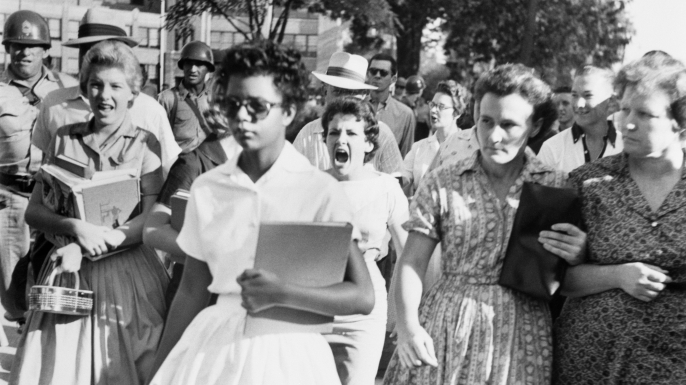
This exercise can be applied to a photo as well as a painting or other work of art. Consider photos that capture emotionally dramatic events like the iconic 1957 image of Elizabeth Eckford, pursued by Hazel Bryan, as she navigates the mob on her way to Central High School in Little Rock. Begin by selecting two students to reproduce the central figures, Eckford and Bryan. Then slowly add class members to the composition one at a time.

Ask students to closely consider the facial expressions of each person. What does the expression tell us about the emotions the person is experiencing in the moment this photograph was made? Push students to consider feelings beyond “mad” or “angry”. Ask them to consider what is motivating the emotions they think they see.

Ask students to discuss how well they think they think understand the people whose faces are not showing a lot of emotion. How can we understand people we can not visually read? Why are some people stoic and others agitated? How does someone maintain composure in such a circumstance?

Finally, ask students to consider who these people are today. Could they ever in their lives be recognized as anything other than who they were at this moment? No one in this photo posed for its making, yet the widespread and ongoing distribution of this photo has defined these people for generations. Ask the students: “How are you defining yourself and being defined by others in social media and other contexts?”

Big Takeaway
Visual texts in any media are powerful primary sources. Exercises like this equip students to examine and unpack these sources when they are doing independent research and help students build the reflective capacity for understanding their own image creation and distribution.

Monday, April 2, 2018

The Social Media Infused Classroom: Mediated Messages 2.0

I have written a few times about my experiences as a member of the Certified Google Innovator #SWE17 cohort and the ongoing learning as part of #GoogleEI . The focus of my application to the Innovator Academy (and the ongoing thread of my work with students and my colleagues) is the development of media literacy. The importance of media literacy can not be understated. Nor can the value of social media as a teaching, learning, and publishing tool.

In the latest iteration of my Innovator project, Mediated Messages, I have added a section on lesson ideas and launched a Facebook group for building a collaborative community dedicated to expanding our capacities for media literacy instruction. Social media is a multi-faceted education tool; it can be used for personalizing instruction, as a research resource, to foster global engagement, and to provide authentic digital citizenship practice. Here are examples of it being used or practiced in each of these contexts.

For Personalizing
In this previous blog post I wrote about my collaboration with an English teacher creating The Selfie Project. Ultimately, as a corollary to their study of Transcendentalism, the students used the makerspace to create 3D representations of self (we called it, "Yourself, in tangible relief"). The project started with an examination of all of the ways a student's identity can be explored, including through playlists, social media, school pictures, the contents of their bedrooms, and their school data. The lesson steps are here and this is a gallery of pictures of the students and their work

For Research
Understanding "Journalistic Truth" and the impact of digital media on our sources of information is essential to student development of savvy research skills. The journalistic truth slides outline a two-period lesson I co-delivered with an English teacher to the students in the non-fiction writing class.

Finding experts and research or non-profit foundations on social media is another excellent way for students to collect valuable insight and potential interview subjects to inform their inquiry.

For Global Engagement
An educator with a global PLN has the resources to connect students with adults and other students around the world for a sharing of culture and point-of-view. Exposure and interaction builds empathy and collaboration. My favorite experience using social media as a teaching tool happened when I was a social studies teacher working with a group of American Studies students. We were studying the cold war and I happened to have a Tweep who is an educator living in eastern Germany. She joined my class for a twitter chat about life in eastern Germany behind the wall and after the wall came down. We were scheduled to chat for 30 minutes and ended up chatting for the entirety of a 70 minute block period. During that time a few of her teacher colleagues joined the conversation as did her daughter who was a student at university. Now my students had both adults and a peer with whom to share perspectives. Several of my students and Ines' daughter began following each other on Instagram, too. The conversation began as a discussion of cold war life and evolved into a discussion of how do we each learn about the other. It was a rich exchange that far exceeded my expectations when Ines and I were planning it!

Teachers at my school haven't yet warmed to Twitter but they are enjoying Flipgrid in closed, classroom-based exercises. Expanding their grids to include participation outside of our school will be a first step building PLNs.

As anyone in the Google Innovator program knows, my cohort, my coach, and my mentor are unparalleled in their support of my work and the counsel they provide. And it's all happening via social media and Google Hangouts.

For Digital Citizenship Practice
I have an on-going collaboration with the teacher of our school's Digital Literacy course. Together we have launched a class Twitter account that the students use to post reflections on lessons and units and provide insights and guidance about good habits of online conduct. To launch this account we had students use Canva to design channel art. We loaded each of their submissions into a Google Form which we pushed to them in Classroom. Students then voted for their favorite design and that was uploaded to Twitter. Then I taught a brief lesson on Hashtags & the Anatomy of a Tweet. The conclusion of the lesson was each student drafting what the first class tweet should be. Again, we shared the submissions with the class and they chose which would be used as our introduction to the Twitterverse.

A Social Media Think Tank for your students is another way to engage them with social media in the context of your course material; here is an elevator pitch you can use with your students.


And that's not all!
My interest in educational use of social media preceded my acceptance into the Innovator Program and new opportunities to continue my learning in this realm have emerged because of the connections I made there. Here are some of the other irons I have in the fire at the moment:

At ISTE18 I will be co-presenting on using social media in the college search and application processes. From building a brand to researching schools to writing the college essay, there are so many ways students can powerfully use social media.

Public libraries in my area are interested in hosting seminars about media savvy and I have a couple happening this month.

My book is about to be released! I co-authored News Literacy: the keys to combating fake news with my friend and fellow librarian, Michelle Luhtala. It will hit the stands in May 2018! I am very excited about the companion video workshops that are being released in conjunction with the book. Those lessons include outreach into social media communities so that the learning is ongoing.


Tuesday, November 21, 2017

If you could teach a course on media literacy... what would it include?


I am in the process of planning a media literacy course. In this post, I am sharing what I have developed so far. What follows is a broad brushstrokes outline a one-marking period in duration (approximately 8 weeks) course. I envision this course becoming a required experience for all incoming 9th graders. Or, at least, a prerequisite for enrolling to work at a student help desk. Please leave comments about how this course can be improved or expanded. Thanks!

UNITS of STUDY:

UNIT 1: SHOULD I SHARE THIS?
Our innate need to receive and share information seems to go hand-in-hand historically with censorship. From Martin Luther’s revolution made possible by the printing press to digital media distributed via the small computers we euphemistically call phones, the power of creating, curating, and distributing information is immense. Napoleon once said, “Four hostile newspapers are more to be feared than a thousand bayonets.” As librarians, each year we promote banned books and websites in order to increase our students' understanding that their access to information is a privilege -- while it should be a right -- that they need to safeguard. Furthermore, when choosing to exercise that right, we tacitly accept responsibility for participating in a manner that advances civil discourse. The challenge of teaching cyber citizen students to be good digital citizens is helping them create space, a moment of reflection, between stimulus and response. Teaching them to be mindful. You might remember the days of walking down the hallway at school and shoving a note through the vents in a friend's locker. Some people shoved unkind notes through locker vents. But, more often than not, the time it took to walk the halls of the school and find the target locker created that space between the stimulus that prompted the writing of an unkind message and the response of slipping it through the vents of the recipient's locker. That hallway walk created the space necessary for better angels to prevail in many cases. What makes today different is the immediacy with which a response to a stimulus can be created and disseminated. A challenge of digital citizenship education is to prompt students to be mindful, to breathe before posting, to reflect on their response before sending their response, to consider whether that response is something they want to be permanently etched into their digital profile.We need to help our students to approach every digital interaction with the same caution that they might employ when they hear the buzz of a tattoo needle. Building empathy is the key to helping students hit the pause button rather than acting (or posting) on impulse.To that end, Unit 1 addresses these questions:
  • What is my online persona and how can I be sure it represents me accurately?
  • What is news and how do I know when something is true?
  • What is my role curating information? (consumer, producer, disseminator)


UNIT 2: HOW CAN SOMETHING BE BOTH BIASED AND MEANINGFUL?
What is true evolves as a news story unfolds. Journalistic truth provides information consumers with the best available account of an event based on the available, verifiable facts at any given time. Even when publishing objective news stories, journalists exercise editorial judgment balancing what their audience wants to know with what they need to know. The target audience for any publication of information is a critical element in determining the manner in which the content is portrayed and disseminated. Professional journalists are trained to remain neutral when reporting; their bylines assure information consumers of their accountability for impartiality or bias. News consumers must remember that opinions included in reporting don’t always indicate bias and that commentary is a part of reporting. One important gauge of the quality of an information source or news outlet is whether or not that publication or agency separates objective reporting from editorial content. News consumers need to know that the content of the editorial pages does not influence the objective reporting of the news.
  • The many faces of me: when can I have an opinion and when must I refrain from bias? Which platform is for which purpose (or which face of me)?
  • When I encounter new information, how do I know when the author’s bias interferes with the meaning and substance?
  • How can I hold my own biases loosely so they do not interfere with what I can learn and understand?

Resources:

American Press Institute: Understanding bias and tools to manage bias
Interesting dialogue about the future of news reporting and the relationship between reporters and their stories
Switched front pages - how we are framed to see and understand media


UNIT 3: WHY CAN'T IS SEPARATE THE MEDIUM FROM THE MESSAGE?
We all have our preferred modes of communication. Frequently those preferences may vary generationally. Creators of content understand those variations. Ads play on television on certain networks at certain times of day to reach the demographic audience most likely to be watching at that time. The same principles are true of other modes of information transmission. The products and ideas sold to a 19-year-old within the video game he is playing (yes, advertisers can and do infiltrate your games) aren’t the same or aren’t portrayed in the same way as the products sold to his 50-year-old mother in her Facebook feed. The same principles apply to fake news or intentional misinformation and hoaxes. The creators of this type of information rely on digital manipulation of images and video and digital transmission to reach wide audiences through viral re-sharing. Message, audience, and medium are inextricably linked.
  • How do advertisers use different media to sell the same product or message?
  • How has the evolution of media changed the way in which information is created, distributed, accessed and used?
  • When deciding how to share what I have learned, how will I consider my audience? Message? Purpose? And create a product that meets all of these needs?

Resources:
Fake News. It's Complicated. (First Draft News)
Urban Legends (About.com)
Grasswire examines social media images in real time to expose hoaxes


UNIT 4: PROBLEM-BASED LEARNING: HOW CAN I USE DIGITAL MEDIA FOR GOOD?
Digital media has transformed our relationship with information and therefore with the global community. We are instantly aware of events happening around the world, we can hear the sounds of war and terror as well as those of harmony and jubilation. We are moved to act by the video footage we see of natural and human-caused disasters. And we join movements for change because we see them playing out on our devices in our hands. Professional conferences even have hashtags for the people not in attendance to follow! (#notataasl7) As we equip our students with the tools and skills requisite to recognize and not be duped by hoaxes and misinformation we must go further and empower them to be digital leaders. The most effective way to combat purposeful, ill intentioned misinformation is by elevating and magnifying the voices engaged in informed civil discourse. Students must learn to use social media not just for interacting with friends far and wide. They must also learn to engage and organize through digital media, researchers, advocates, fund-raisers, politicians, non-profit organizations, and other problem solvers in order address the needs of their communities.
  • What issue, problem, or cause do I care about? Why?
  • How can I take informed action?
  • How can I contribute to a solution or remedy?
    • Design cycle
    • Presentation of plan
  • Whom am I trying to reach (who is my audience)?
  • How do those people most frequently access information? Why?
  • What is the best media for conveying my evidence and conclusions? Consider:
    • Do I need photographs or other artist renderings?
    • Do I need data visualization?
    • Are voices, music, or other auditory files important to understanding my message?
    • Is there a need for video footage?
    • How much text do I have? Does it require hyperlinks or interactivity?
  • How will my product reach my audience?
    • Will it live on a website?
    • Post to a video sharing forum like YouTube?
    • Be delivered via email?
    • Exist in printed form?
    • Be performed or delivered to a live audience?
    • Something else?
  • How will the talents of my team combine to create a successful product or presentation?

Resources:
By Any Media Necessary: The New Youth Activism by Henry Jenkins and Sangita Shresthova

Monday, October 16, 2017

To teach digital citizenship & literacy, we must be digital neighbors

I was fortunate to be accepted into the Stockholm cohort (#SWE17) of the Google Innovator Academy (#GoogleEI). The focus of my work for my Innovator project is students' digital media literacy (or lack thereof). Based on the SHEG report, Evaluating Information: The Cornerstone of Civic Online Reasoning, and other reading I have been doing about this topic, I initially thought the focus of my work would be on developing students' capacities for unpacking, critically examining, and making meaning of the myriad of digital texts that flood their social media feeds. Following the protocols the Innovator team outlined for us in advance of attending the Academy, I quickly realized that I had a different -- but related -- issue to tackle before addressing student digital literacy. That is, the lack of social media, and thus digital media not curated by a teacher, that is used or experienced in the classroom. Until teachers embrace social media as a teaching, learning, and communication tool, students will not have an opportunity to be guided in the development of their digital literacy. Thus my project: social media think tanks for any classroom. You can learn more about it at my site: Mediated Messages.

Here is my 90 second elevator pitch:


For many years I have sat through faculty meetings where district lawyers have warned us about our social media presence and connections with students. I suspect that the concerns that inspire those cautionary meetings and the policy that as educators we may not be social media friends with our students will result in push back against my project. Yet, I think it is possible for it to work. In fact, if we really mean we want to teach students positive habits of digital citizenship, then it is essential that we interact with them in digital communities.

My daughter is a field hockey player. Her team, like most other teams of which I am aware, self-organizes in a closed Facebook group. All current team members are invited as are the coaches and parents of current players. Announcements are made in this forum, pictures of games and spirit days are shared here, encouraging messages about upcoming games are offered. I am an active contributor to this group even though I am not Facebook friends with most of the group members.

I am also a member of professional Facebook groups like ALA Think Tank and Future Ready Librarians. Again, I contribute to the discussions that happen in these groups. I learn from the postings made by group members and I am not "friends" with most of the people in that group. The posts I make to my page, that are shared with my friends, are not part of that forum. In that way, I can keep my personal and professional postings and communities separate.

Twitter is another social media platform on which I am rather active. I follow many people and many of them follow me as well. There are many people with whom I engage in discourse via hashtags but we do not follow each other. My habit when it comes to Twitter is only to follow people's professional feeds. I do not use Twitter for personal posting. And, by following a hashtag, I can learn from people who contribute to that hashtag discussion without following their entire feed.

As I see it, the use of closed Facebook groups and hashtags allows teachers and students to interact on social media and still maintain a separation of their personal lives. Further separation can be achieved by the creation of classroom accounts. How ever teachers and administrators choose to structure conversations -- many athletic coaches have already figured it out -- we aren't really teaching digital citizenship or information literacy if we aren't digital neighbors.