Showing posts with label kinesthetic. Show all posts

Monday, April 23, 2018

Living Tableaux: kinesthetic lessons in empathy and digital citizenship

Whether you are a library media specialist, a teacher of social studies or art history or ELA or any other discipline that incorporates art and photography as a teaching tool or element of content, building living tableaux -- people posing to replicate a 2D image -- is a classroom exercise that has so many learning benefits for students! It is a kinesthetic experience that challenges students to develop empathy with the figures being depicted and even fosters conversations about digital citizenship.

Kinesthetic
To form a tableau, I allow students time to scan the painting, then ask them to choose a person on whom they want to focus. Alternately, you can group the students and assign each group one character from the painting to consider. Then I ask students to stare at just that person and to think and wonder about that person while looking at him/her. I give them a moment to jot down what thoughts, feelings, and questions they have before moving to the next step. For this exercise, let’s imagine that we are studying Experiment on a Bird in the Air Pump by Joseph Wright.

Once students have collected their thoughts, I ask for a student from each group to volunteer to become the person s/he scrutinized from the painting. These students then assemble themselves in the middle of the classroom in a re-creation of the painting. Once they are set, the rest of the class can adjust “the posers” by re-positioning them for accuracy, directing their body language and facial expressions. They may apply props from the classroom to enhance the living replication of the original. 

Empathetic
Students will have to break the tableau to participate in the discussion so, if possible, take a picture of the students in their arrangement and post it for them to see alongside the image of the original work. When analyzing and discussing paintings, I always remind my students that every element of a painting is the conscious choice of the artist. Even happy accidents that remain in the final work do so because the artist decided they should stay. Every color, brushstroke, facial expression, object is there by choice and design. Therefore, as viewers of the painting, in order to fully engage in the artist’s message, purpose or intent, we must ask “Why?”

Before discussing, I ask students to engage in some reflective writing. I give them a few minutes to collect their thoughts about what their person: thinks, feels, wonders, fears, hopes, sees, believes. I prompt students to consider gender and gender identity, age, attire, body language, facial expression, relationship to the group, etc. as they collect their thoughts. Before we discuss the painting as a class, the students share these reflections with their small group.

I transition to whole class discussion by asking those students who posed in the tableau to share how it felt to be the person? What were they thinking about as they held the facial expression and posture of their person?

Then, I ask other students to share their observations of the person they examined. Once they have explored the figures individually, I prompt them to consider the relationships between the people in the painting and finally, I ask what they think this painting is about. For an artwork like Joseph Wright’s Experiment on a Bird in the Air Pump, I prompt them to push past the literal… it is a painting about an experiment (which it is), because it is also a painting of risk-taking, of questioning or inquiry, of seeking answers, of fear. In fact, I have used this painting as an introduction to a unit on the Enlightenment and students have come to the conclusion that this is a painting of the moment of becoming Enlightened. At that point, I draw their attention the man in red. Why is he (and the bird) the only person looking at us, the viewer? What is our role in the experiment? Why did the artist make us complicit in the secret proceedings?

Once you know something, you can never un-know it. Once people start to question and seek answers and learn new realities, the world can never be the same. Welcome to the Enlightenment!

Citizenship
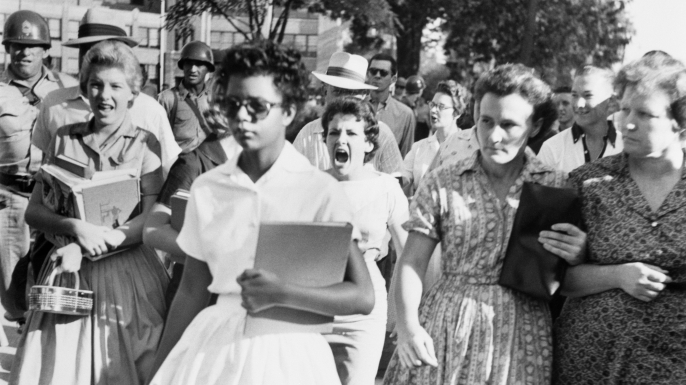
This exercise can be applied to a photo as well as a painting or other work of art. Consider photos that capture emotionally dramatic events like the iconic 1957 image of Elizabeth Eckford, pursued by Hazel Bryan, as she navigates the mob on her way to Central High School in Little Rock. Begin by selecting two students to reproduce the central figures, Eckford and Bryan. Then slowly add class members to the composition one at a time.

Ask students to closely consider the facial expressions of each person. What does the expression tell us about the emotions the person is experiencing in the moment this photograph was made? Push students to consider feelings beyond “mad” or “angry”. Ask them to consider what is motivating the emotions they think they see.

Ask students to discuss how well they think they think understand the people whose faces are not showing a lot of emotion. How can we understand people we can not visually read? Why are some people stoic and others agitated? How does someone maintain composure in such a circumstance?

Finally, ask students to consider who these people are today. Could they ever in their lives be recognized as anything other than who they were at this moment? No one in this photo posed for its making, yet the widespread and ongoing distribution of this photo has defined these people for generations. Ask the students: “How are you defining yourself and being defined by others in social media and other contexts?”

Big Takeaway
Visual texts in any media are powerful primary sources. Exercises like this equip students to examine and unpack these sources when they are doing independent research and help students build the reflective capacity for understanding their own image creation and distribution.

Tuesday, January 16, 2018

The Tempest, Character Boxes, and Students in the Garage

The Shakespeare class has returned to the Garage to begin assembling their character boxes as the final assessment for their study of The Tempest. The students were given three options which I wrote about in a previous post. All of them chose the independent box project. Here are the guiding questions and criteria:

What kind of box or container best fits this character? (could be a steamer trunk, magical cabinet, barrel, burlap sack, coffin, etc.) Why? And how will you show this?

Does this box ground this character to a place or allow (force?) this character to move? Why? And how will you show this?
What does this character:
    • Hope?
    • Fear?
    • Believe?
    • Desire?
    • Wonder?
    • Deny?
    • Aspire?
    • Want?
    • Plan?
As a result of the attributes above, what would s/he put in the box? Find or make those things to add to your box, at least one item per attribute. Justify each selection with an excerpt from the play.

As a result of the attributes above, what else would be in the box whether or not s/he wants it there? Add it to the box and justify it with an excerpt from the play.

Design the outside of the box to resemble how the world sees the character; design the inside of the box to represent how the character understands him/herself.

Some students found the container or box they want to use and are letting the form of the box dictate how their other choices evolve. Other students are building their box out of a particular material because of what the material will say about their chosen character. Still others are beginning with the form or shape they want their box to be and then coating, layering, and transforming the shapes of the inside and outside of the form to become the appropriate container for their character.

Similarly some students are starting with the outside of the box and working their way to the inside and then to the contents. Other students are starting with the contents and developing a box that will be able to contain them.

Here is how one student described her thought process:


This kinesthetic, multimedia project has gotten their creative juices flowing and the students are requesting lots of materials. Some (but not all) of the materials or items I can bring to them from my garage at home. I sent an email to the faculty and staff which said:

WHS Learning Community,

The Garage (formerly the LLC makerspace) is in need of some materials for student projects that are currently underway. If you happen to have, and are about to discard:
    • crates from clementines or other produce,
    • drawstring (or other style) sacks of any material,
    • perler beads, or
    • fake flora: flowers, leaves, etc.
students are requesting these materials for a project they are doing.

We will gratefully accept donations of any materials you are looking to dispose that can be up-cycled, recycled, and re-purposed in student projects. Scraps of fabric, old baskets and crates, random hardware, etc. If you aren't sure if we can use it, shoot me a quick email -- the answer will probably be YES!

Thank you!

Many people have responded offering all sorts of materials from the items on the list to all sorts of other materials. We will soon be flush with new resources! And many people are offering to deliver their donations which will increase traffic through the space and hopefully result in more teachers bringing their classes to work in the Garage!

Later this week, the class will return to the LLC and present their boxes to each other. When the teacher asked if they would rather conduct presentations in the classroom or in the library, they unanimously chose the library!

Thursday, December 8, 2016

Lessons learned from experimenting with VR

We are investigating different ways to use augmented and virtual reality to enhance teaching and learning. At this point our approach may be a bit haphazard as we play with different free devices, apps, and triggers in our pursuit of a full curricular adoption of a VR platform. Such adoption is a long way off. In the meantime we are gaining increasing appreciation for the learning potential of a robust system as we watch our students interact with the modest tools in our makerspace.

A tool we have: a class set of cardboards
The obstacle we face: no devices to insert into the cardboards

Another tool: In addition to their BYOD devices, students bring smartphones to school
Another obstacle: our state has a student data privacy law that significantly restricts the digital platforms to which teachers can direct students for classroom exercises.

So here is what we have tried:
Having recently upgraded my phone, I donated my old android phone to our TechXperts. I showed them the roller coaster cardboard app and then got out of the way. They started by creating elastic head straps to turn the cardboards into hands-free devices. They scoured the play store for VR experiences compatible with the single device we have and began wandering the makerspace wearing the headset. Students started clambering: me, too! me, too! and the line formed of students waiting for a turn.

Lesson 1: Students are always game for a new learning experience.

Once the furor abated I tried out the apps they installed and wandered around a fantasy world for a while. I moved around my physical space as I moved around the virtual space. I jumped, squatted, spun, reached, walked... I moved.

Lesson 2When you are looking for ways to introduce movement into your classroom, VR is a great tool for kinesthetic learning!

After the fantasy exploration, the students tried to get me to cliff dive, and I was done. The roller coaster app was not enough for them. They needed to free-fall through space! I told them when I tried Google Expeditions at ISTE2015, and found myself on the side of Everest, I fell out of the chair was helped off the floor by a very sweet Googler who assured me that I wasn't the first person to do that. Still embarrassing.

Lesson 3: VR experiences are visceral and can help students develop empathy.

Augmented reality is cool, too. While less immersive, AR experiences have similar and important impact on teaching and learning. On a recent professional learning day, we set up a playground for teachers to visit between workshops or as a workshop session. One of the playground stations was an AR station. We downloaded the chemistry and anatomy triggers from Daqri, installed the Daqri app on the library iPads, and invited teachers to play with the element, heart, and body systems enhancements. Say goodbye to cellophane overlays that build the systems of the body in increasingly difficult to read layers! Now the systems can be added and removed by a touch of the finger and they layer and intertwine with one another as they do in a body.

Lessons 4&5: The interactive, multi-media, self-directed nature of VR and AR helps students orient to challenging concepts and gives them agency over their interaction with the content.

In the library specifically we are resurrecting a past initiative using Aurasma to create triggers out of book covers. When students meet in the library to select independent reading material, we are capturing short videos of them reviewing their books. Then, we make the video an overlay with the cover as a trigger. Students -- any library patron, really -- can follow our channel and scan the covers of books to see what fellow students say about them! Now, AR is not just about consuming information, but about the creation, by students, of new insights, learning, and content.

Lesson 6: In small and large ways, AR and VR experiences encourage students to explore previously inaccessible ideas and places expanding their passions and curiosity.

Needless to say there are much more expansive AR and VR experiences available for education than those in which we have dabbled. Our little experiences are helping us build a plan for more curricular integration of such experiences -- and more financial investment, too. In the meantime, these dabbles are helping us to expand our thinking about how to enhance teaching and learning, beyond the wow! factor.