Showing posts with label reflection. Show all posts

Monday, April 23, 2018

Living Tableaux: kinesthetic lessons in empathy and digital citizenship

Whether you are a library media specialist, a teacher of social studies or art history or ELA or any other discipline that incorporates art and photography as a teaching tool or element of content, building living tableaux -- people posing to replicate a 2D image -- is a classroom exercise that has so many learning benefits for students! It is a kinesthetic experience that challenges students to develop empathy with the figures being depicted and even fosters conversations about digital citizenship.

Kinesthetic
To form a tableau, I allow students time to scan the painting, then ask them to choose a person on whom they want to focus. Alternately, you can group the students and assign each group one character from the painting to consider. Then I ask students to stare at just that person and to think and wonder about that person while looking at him/her. I give them a moment to jot down what thoughts, feelings, and questions they have before moving to the next step. For this exercise, let’s imagine that we are studying Experiment on a Bird in the Air Pump by Joseph Wright.

Once students have collected their thoughts, I ask for a student from each group to volunteer to become the person s/he scrutinized from the painting. These students then assemble themselves in the middle of the classroom in a re-creation of the painting. Once they are set, the rest of the class can adjust “the posers” by re-positioning them for accuracy, directing their body language and facial expressions. They may apply props from the classroom to enhance the living replication of the original. 

Empathetic
Students will have to break the tableau to participate in the discussion so, if possible, take a picture of the students in their arrangement and post it for them to see alongside the image of the original work. When analyzing and discussing paintings, I always remind my students that every element of a painting is the conscious choice of the artist. Even happy accidents that remain in the final work do so because the artist decided they should stay. Every color, brushstroke, facial expression, object is there by choice and design. Therefore, as viewers of the painting, in order to fully engage in the artist’s message, purpose or intent, we must ask “Why?”

Before discussing, I ask students to engage in some reflective writing. I give them a few minutes to collect their thoughts about what their person: thinks, feels, wonders, fears, hopes, sees, believes. I prompt students to consider gender and gender identity, age, attire, body language, facial expression, relationship to the group, etc. as they collect their thoughts. Before we discuss the painting as a class, the students share these reflections with their small group.

I transition to whole class discussion by asking those students who posed in the tableau to share how it felt to be the person? What were they thinking about as they held the facial expression and posture of their person?

Then, I ask other students to share their observations of the person they examined. Once they have explored the figures individually, I prompt them to consider the relationships between the people in the painting and finally, I ask what they think this painting is about. For an artwork like Joseph Wright’s Experiment on a Bird in the Air Pump, I prompt them to push past the literal… it is a painting about an experiment (which it is), because it is also a painting of risk-taking, of questioning or inquiry, of seeking answers, of fear. In fact, I have used this painting as an introduction to a unit on the Enlightenment and students have come to the conclusion that this is a painting of the moment of becoming Enlightened. At that point, I draw their attention the man in red. Why is he (and the bird) the only person looking at us, the viewer? What is our role in the experiment? Why did the artist make us complicit in the secret proceedings?

Once you know something, you can never un-know it. Once people start to question and seek answers and learn new realities, the world can never be the same. Welcome to the Enlightenment!

Citizenship
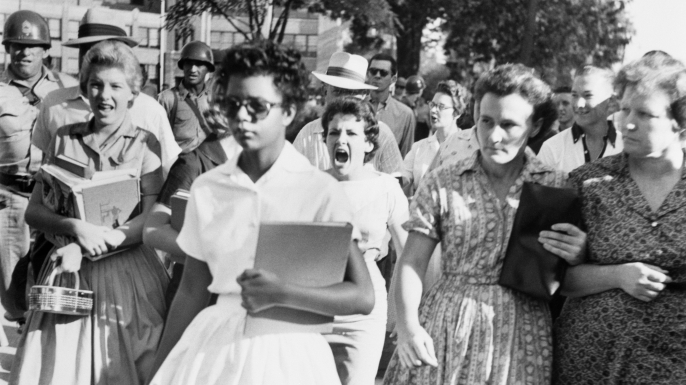
This exercise can be applied to a photo as well as a painting or other work of art. Consider photos that capture emotionally dramatic events like the iconic 1957 image of Elizabeth Eckford, pursued by Hazel Bryan, as she navigates the mob on her way to Central High School in Little Rock. Begin by selecting two students to reproduce the central figures, Eckford and Bryan. Then slowly add class members to the composition one at a time.

Ask students to closely consider the facial expressions of each person. What does the expression tell us about the emotions the person is experiencing in the moment this photograph was made? Push students to consider feelings beyond “mad” or “angry”. Ask them to consider what is motivating the emotions they think they see.

Ask students to discuss how well they think they think understand the people whose faces are not showing a lot of emotion. How can we understand people we can not visually read? Why are some people stoic and others agitated? How does someone maintain composure in such a circumstance?

Finally, ask students to consider who these people are today. Could they ever in their lives be recognized as anything other than who they were at this moment? No one in this photo posed for its making, yet the widespread and ongoing distribution of this photo has defined these people for generations. Ask the students: “How are you defining yourself and being defined by others in social media and other contexts?”

Big Takeaway
Visual texts in any media are powerful primary sources. Exercises like this equip students to examine and unpack these sources when they are doing independent research and help students build the reflective capacity for understanding their own image creation and distribution.

Wednesday, March 14, 2018

Hacking Assessments with Augmented Reality

In my new role I am overseeing the students enrolled in our help desk course. I am in the process of invigorating a program that has been languishing. To do this, the I returned to the core of what the program is supposed to be or supposed to accomplish: independent learning by students and service to the community. Each student has identified a problem, of sorts, that they want to solve, they are working through design thinking protocols to develop and prototype solutions as well as identifying areas of new learning for themselves in order to implement the solution.

Two students have partnered to help revamp our freshmen orientation and new student transition programs by creating a 3D virtual tour of our school.

One student is investigating high levels of stress in shelter animals and plans to use our makerspace to create toys and other tools for donating to local shelters.

Another student is responding to teacher frustrations with our current program for reporting grades by building a grade book as a Google add-on.

Yet another student is hacking assessment.

He decided that the problem he experiences impacts his classmates as well, and that is, lack of choice in assessments. From his perspective, students are assigned to do the same thing in all of their classes. No variety and little choice. So he is learning augmented reality tools to systematically hack assessments that are assigned to him. His goal is to apply an AR hack to one assessment in each discipline over the course of the semester.

He has started by using Metaverse to create a guide to solving a complex math problem. He is anticipating all of the errors a student could make while solving the problem and using his AR tour to provide hints and redirection. This is the student explain his progress so far, obstacles he has encountered, and how he is getting around them.


He is still doing all of the work that is assigned to him. He is using the one period each day during which he is assigned to help desk, to show the same learning his teachers expect in a different (and personalized) way. When he is done, he will share both products with his teacher: the assigned one, and the hack. Once he has completed two or three of them, we plan to offer an "Appy Hour" seminar for faculty to learn from him about his projects and what he is learning along the way.

To that end, he is regularly sharing with me his metacognitive moments along the way. Here he is sharing his reflection about learning while working on his math problem:


Tuesday, November 14, 2017

Big Takeaways from #AASL17

I have returned from three days communing with my library peeps and tweeps at the AASL conference in Phoenix carrying a (way too pricey) book of the new AASL standards, a little schwag, some signed picture books, a couple of Google docs of notes, lots of links to presentations, and a timeline of tweets highlighting the sessions I attended.

On Saturday I had an opportunity for a lengthy conversation with my friend and colleague Michelle Luhtala about news literacy. If you are an attendee of Michelle's edWeb webinars then you know this is an important topic to us both that we frequently discuss on and off the air! This private conversation was a warm-up to our presentation, delivered along with our other friends and colleagues Joyce Valenza and Shannon Miller, about helping students develop the research skills that are critical in the digital information age. You can access our slides and join our padlet community to continue the conversation and research curation around this topic.


We arrived in Phoenix on Thursday with a presentation outline ready to be delivered on Saturday. In the interim, we spent some intense time both in and out of conference sessions examining the newly released and much anticipated standards. This release necessitated a revisiting of our presentation which we were pleased to discover aligned with the shared foundations. Given our focus on research, we emphasized "Inquiry" and "Curate," and, as happens with most standards, found that the others (Include, Collaborate, Explore and Engage) were infused throughout our conversation because of the natural interweaving through the domains (Think, Create, Share, Grow). I took this coincidence as validation of both the development of solid inquiry models in our respective districts and thoughtfully developed standards that reflect the needs of learners and educators striving to be critical thinkers in the digital information age.

The Inquiry Model that informs my instruction has five phases. Each phase is a step in the process from topic selection to final product, and each step is infused with opportunities for students to collaborate and reflect.

Step 1: Wonder - Topic Identification & Question Formulation

What do I...

  • wonder about? (curiosity)
  • wish I could change? (problem solve)
  • wish I understood better? (critical thinking)

How can I...

  • generate possible questions?
  • provide innovative solutions to authentic problems?
  • pose a clear, well-developed research question?


Question Generation Protocols

Collaboration

  • Have I solicited feedback from other people about the scope of my questions?
  • Have I discussed or brainstormed about my topic or the problem I am trying to solve with other people studying a similar or related topic?


Reflection and Metacognition

  • Regarding Time Management
  • Have I planned backwards from the due date to give myself progress check points along the way?
  • How do I schedule my homework?
  • How can I fit regular work sessions into my plan?
  • Would work days in class be helpful to me or are they not productive time?
  • How can I capitalize on meeting, conferencing, and collaboration in order to get the input or inspiration that will help me?

Step 2: Curate: Locate All Relevant Media

Where will I:
  • gather background information and begin my investigation?
  • locate information from multiple and differentiated quality sources?
How can I:
  • “tweak” my search terms as needed?
  • find a range of sources in various types of media to be sure I am including a wide range of perspectives?
Finding What You Need
Accumulate Good Search Terms
  • Start with Wikipedia
  • Imagine your dream source: what words would be in it?
  • Already found a good source? What new keywords does it contain for you?
  • What are synonyms for the keywords you already have?
School and Local Resources
  • Destiny
  • Our Databases
  • ResearchITCT
  • Interlibrary Loan
  • Wilton Library Association

Make Google Do Your Heavy Lifting
  • Site searching
  • Search by Filetype
  • Go back in time
  • Use Advanced search for truncation, wildcard, and Boolean operators
  • Google Scholar
  • Google Books

Extending Your Search
  • Move past reference sources into scholarly and primary using Advanced search functions
  • Mine the citations from a good source you have already found
  • Search by author; who is an authority on your subject? Who is the author of good sources you have already consulted?
  • Stop searching… can you interview an expert?
  • HASHTAGS! What advocacy organizations, interest groups, think tanks or other agencies address your topic? What hashtags are associated with the topic? Start trolling social media!
Collaboration
  • If I am trying to solve a problem through my research, have I identified and interviewed stakeholders who represent a range of perspectives on or experiences with the problem I am addressing?
  • Have I asked someone to challenge my conclusions and help me expose how my own biases might interfere with my research?

Reflection and Metacognition
  • About Reading & Note Making Strategies:
  • How is the content reading going?
  • Have I learned anything (content or process) from my secondary source reading and primary document examinations?
  • How have my presuppositions been challenged?
  • Am I allowing my preconceptions to be challenged?
  • Are my views changing?
  • When I read HOW did I read?
  • Do I print out the documents or read them on line?
  • What did I do to prepare to read them? how did I know what to look for or focus on?
  • If I printed them out, did I have paper to make notes one while and after I read?
  • If I read them on line, did I copy them into a file where I could annotate such as Google Docs?
  • If I highlight is it just to keep my eyes focused on the page? How do I know what to highlight?
  • What do I write down? what questions do I ask? what do I write about when I finish reading?
  • If the document is long, do I read it in sections? What do I do at the end of each section?

Step 3: Explore the Information Superhighway: Evaluating Sources

How can I:
  • assess the authority, accuracy, relevance and purpose of my sources?
  • organize my notes and know that my consideration of perspectives is thorough?
  • include multiple and informed perspectives?
The Information Superhighway

Thinking Like a Fact-Checker

Reverse Image Searching

Citing Your Sources
  • Noodletools
  • OWL Purdue

Collaboration
  • What changes have I made in response to feedback from other people? How did I undertake those changes? How did they improve my work?
  • Is there any perspective I have yet to consult? Who can help me access this point-of-view?

Reflection Questions about Critical Thinking:
  • What are the major content/critical thinking/writing issues that I have been confronted with in this project?
  • How well do I understand the content/substance of what I have been thinking about for this project?
  • What is my plan or strategy to address issues I am encountering with this project? Is this plan similar to the plans I have used in the past? How, and why, did I know these steps would work? Is my plan working?
  • What do I think my main goals should be as a thinker given what you have experienced so far in this class? Why are these my goals?
  • What is my criteria for quality work? What areas of the rubrics are still unclear to me? How am I attempting to reach clarity about these areas?
  • What was the most important thing I have learned about yourself as a thinker so far?

Step 4: Create an Argument: Applying Learning

How can I:
  • select and effectively use tools to organize myself?
  • synthesize what I have learned from my research?
  • create an arguable thesis?
Tools & Techniques:
For Your Thesis:

For Citations, Note Organizing and Outlining:
  • Noodletools
For Outlining, Webbing & Other Planning Strategies:


Collaboration:
  • From whom did I solicit feedback on my thesis and/or my outline? Why?
  • What feedback did I incorporate? How did it improve my plan?
Reflection:
  • How might my opinions have had an impact on whether or not I stayed open to conflicting information?
  • How did I check myself to be sure I held my bias loosely?

Step 5: Communicate, Share & Grow

When deciding how to share what I have learned, how will I consider my:
  • audience?
  • message?
  • purpose?
And create a product that meets all of these needs?
How can I take informed action?
Things to Consider:
  • Whom am I trying to reach (who is my audience)?
  • How do those people most frequently access information? Why?
  • What is the best media for conveying my evidence and conclusions? Consider:
    • Do I need photographs or other artist renderings?
    • Do I need data visualization?
    • Are voices, music, or other auditory files important to understanding my message?
    • Is there a need for video footage?
    • How much text do I have? Does it require hyperlinks or interactivity?
  • How will my product reach my audience?
    • Will it live on a website?
    • Post to a video sharing forum like YouTube?
    • Be delivered via email?
    • Exist in printed form?
    • Be performed or delivered to a live audience?
    • Something else?
  • How will the talents of my team combine to create a successful product or presentation?
 Frankly, as much as the announcement of the new AASL standards validated and encouraged this research process as a model for working with high school students, the keynote address by Google Education Evangelist from Hell's Kitchen, Jamie Casap, inspired the bulk of my tweets as well as the metacognitive food for thought that nourished me through lots of sessions and late nights in Phoenix.

I work with high school students so I don't think I have ever asked a student what s/he wants to be when s/he grows up. But, I have certainly asked, "what will you do after graduation?" or "what do you want to study?" Still, Jamie's question: "what problem do you want to solve?" not only by-passes the issue that we have no idea what jobs will even be possible for our students when they "grow up;" it also infuses students with empathy and agency. I know if there are two qualities I hope my teenagers have or develop it is empathy and agency!
And so, I return to our inquiry model and ask: at every stage, are students developing empathy and agency? Will they graduate from four years working with these protocols prepared to engage with other people's point of views, able to gather (with fidelity) the insight and opinions of stakeholders, and apply themselves to solving the problems in their communities in the interest of improving the educational, socioeconomic, political or environmental  conditions of their day?

As long as I can keep answering yes to those questions, then I know I am on the right path.

Saturday, November 12, 2016

Research, Collaboration and Mapmaking -- by Students

I am getting very excited about a new project I am co-planning with one of my science colleagues. We are collaborating to re-vision the unit on global warming. My colleague presented me with an idea about having the students work in small groups or pairs to examine indicators of global warming in different regions of the world. I immediately started thinking about MAPS! In particular, about how perfectly this project lends itself to the documentation of student research and insight in Google My Maps.

And so a project was born!

We've been working this week to develop the project and when working realized that all of these ninth grade students have done a project in their social studies class earlier in the year where they examined a nation in terms of HDI and the nutritional wellness of the people. The title of the project is "R U What U Eat?" It totally makes sense, then, to group the students by the countries they examined in this earlier mini-research project and have them continue to expand their insight about that region of the world.

Originally we were going to assign students to countries and provide them a short (2-4 paragraph) regional climate summary and then guide them in developing research terms so they could learn more about that country or region. Now, they have already provided that information for themselves in the research they did earlier this year in social studies. So, we are going to give them a brief reading about the indicators of climate change and they will be ready to begin researching. Ultimately, they are being asked to make a prediction about the climate health of their assigned region. This is a difficult task for ninth graders so we are providing them with this organizer for their research and guide for developing predictions:


People
Food & Crops:

Mobility & Travel:
Other:
Population
Density & Distribution:

Major Cities:

Other:

Economics
GDP:

Major Industries:

Other:

Geography
Longitude & Latitude:

Land Forms & Sea Level:

Other:

Climate
Precipitation & Storms:

Seasonal Variation:
Other:

Now, consider these combinations:

  • Population Density + Major Industry + Storms = ?

When you combine the different factors from the table, what trends appear?

  • Look for CAUSE & EFFECT… if _______ happens, then _________ will happen next.

Review your research and then develop your prediction for your region.


Ultimately, each group will be given a layer in a Google My Map in which they will present their research and predictions. They will be able to outline and color code regions, drop pushpins in important locations, display images and video, as well as write text (including their citations). When all of the student research and insight is compiled, the map will serve as an interactive way for students to examine the globe and compare regions by turning layers on and off. We are providing them with these questions to guide their reflection:


  1. Was it difficult to make predictions, even with the information and knowledge you had? Why or why not? What additional information or tools would be helpful in making more accurate climate change predictions?
  2. How important do you think it is to make accurate projections about climate change in order to take steps to reverse, mitigate, or prevent climate change? Explain your thinking.
  3. What kinds of connections did you discover between climate change impacts in your country and other countries? How might humans in your environment be impacted by climate change in other environments?
  4. Are any environments impacted more (i.e., more sensitive or vulnerable to climate change) than others? What characteristics of these environments make them especially sensitive to climate change?
  5. What are some variables that are likely to affect the rate of future climate change? (E.g., population growth, economic development, global equity, type, and efficiency of energy use.)
  6. What actions do we take that contribute to the impacts of climate change on other environments? What can we do to mitigate the impacts of climate change on other environments?

What more could we ask for in this project? We are eager for it to begin!

Monday, October 31, 2016

Another PD Session: Student Discussions and BYOD

I have been pondering how to provide my colleagues who attend the sessions I am facilitating with the materials and prompts that will guide their work. For the Assessment and BYOD workshop that I discussed in my last post, I decided to organize all of the materials in a Google  Site so that participants can have easy access to all of the materials.

That same day, I will be facilitating a second session on a different topic. The focus of my second workshop will be on managing classroom discussions in a BYOD environment. This is our school's first year with BYOD so it is a focus of our professional learning. Furthermore, we are also committed to increasing personalization of learning for the students. I am working to keep those two goals as threads in my workshop. I hope that participants finish the sessions empowered to harness tech for more student-centered learning experiences.

The sessions are each 90 minutes long. For discussion, I have divided the time into two segments. In the first segment, we will examine whole-class discussion protocols; in the second segment, we will consider student-managed small group discussions. Participants will be immersed in the discussion protocols were are examining and use the technology that students can use to support and document their interactions and reflections.

Agenda for the Whole Class Discussion segment:
(Rubric)


Round 1

  • Select volunteers to chat in the fishbowl
  • Review Fishbowl Norms: only those in the center can talk; all participants can contribute to the chat room.
  • Everyone will join TodaysMeet chat room and see this greeting: "Welcome to the chat! Enter your comments here. Remember you are limited to 140 chars. Talk to each other by using @ protocol. I am @JackieW"
  • Watch this Michael Jordan commercial


  • Discuss: “What is a growth mindset, and why do I need one? How can my students develop one?”


Round 2

  • New group goes into fishbowl
  • New question introduced into chat: What does it mean to describe an assessment or classroom experience as "authentic”?
Closure:
  • Everyone post “big takeaway” in the chat; start post with BT
  • Archive chat transcript as a Google doc; share for reflection
  • Demonstrate Ctrl-F, search for user name to see where posted
Questions for Reflection:
  • I used to think... and now I think...
  • If I had been in the fishbowl I might have said...
  • One thing I wanted to say but didn't was...
  • The most important understanding I am taking away from this discussion is... and it is important because..
  • The most insightful comment I heard today was... and it was insightful because...

Agenda for the Small Group Discussion segment:

Discussion Protocols:
  • Each group member has a different role
  • For each role, there is a padlet or slide for collecting ideas
  • Readers populate the padlet or slide assigned to their role
  • Readers can draw upon the postings of classmates when discussing in small groups
Reading Roles: (text: In the Beginning... Was the Command Line, "MGBs, Tanks, and Batmobiles" by Neal Stephenson)
  • Questioner: what would you ask the people in the passage if you could? Why?
  • Connector: of what are you reminded when you read this passage? (book, movie, tv, current event…) Why?
  • Wonderer: what do you want to know about this situation? Why?
  • Predictor: what do you think the outcome of the conflict will be? Explain.
  • Passage Picker: select the passage you think is key to understanding the text. Explain its importance.
Jigsaw:
  • Assign everyone in the group the same role
  • Read and share ideas
  • Collect ideas on a padlet assigned to their role
  • Rearrange groups so that each new group has someone from each role
  • Discuss
Asynchronous Discussion Extensions:
  • Students can post to a blog with their understandings derived from their reading role
  • Students can Skype or Google Hangout with other students discussing the same issue or topic

Instead of another Google Site, for the Discussion session I created a series of Padlets. This way, there is a materials reference for participants to follow as the session unfolds, a collection of resources to which they can return after the session. And, if anyone attends both sessions I am facilitating, s/he also sees different technology being modeled for activity management and materials delivery.

Wednesday, October 26, 2016

Outline for my PD session on ASSESSMENT and BYOD

In my previous post I commented that I had planned a professional learning session and was giving the outline a little time to settle in my brain before finalizing my plans. So, my plans are finalized. Of course, I don't have to offer this session until November 8 so there is still time for improvement!

Here is how I envision the 90 minute session unfolding:

Session Focus: Assessment
General Directions:
The room will be arranged into six groups of 4 team members each. Each group will be assigned a particular type of assessment and content. Duplicate groups can be added as necessary. The groups are:
  • Board or Card Games with a science unit
  • Travel Posters for an English (literary) setting study
  • Memes for math principles
  • Superbowl Commercials for world language
  • Song Parodies and Music Videos for a health topic
  • Movie Posters and Video Trailers for social studies

Participants can choose to work in interdisciplinary or departmental teams.

Procedure:
For this exercise, each team will be assigned a content focus and a product to create. Working in teams of no more than four, they will follow the directions that accompany their assigned topic.

All teams will be given a model to unpack. They may identify or locate an alternate model if it pleases the group members. (10 minutes)

All teams will be given prompts to guide them in creating their assigned project.

All teams will have time to work to devise a project plan (25 minutes)

When plans are complete, groups will discuss what skills are required for successful completion of the project, to what extent the project assesses required content knowledge, how to evaluate the projects, and how to apply the concept to their curricula. (15 minutes)

Closure:
Each group will share the content they were assigned, the project they had to develop, and how the group approached the task. (20 minutes)

Participants will discuss the skills necessary for each assessment, how project-based learning changes the students’ experience, how BYOD supports this assessment approach. (10 minutes)

Recommended Rubrics:

Here are the specific directions that will be provided to each group:

BOARD or CARD GAMES
Purpose:
Demonstrate knowledge of the structure and function of a cell

The Process:
  1. Start with a game you know and like and unpack it
    1. What is the objective of the game?
    2. What strategy or skills are required?
    3. What background knowledge or experience is necessary?
    4. What materials are included? (Don’t forget about the directions!)
    5. How many players can participate?
    6. What obstacles do players encounter?
    7. Do you play against the clock? Against other players? Something else?

  1. Consider your content
    1. How can a player show mastery?
    2. What are the parts of the whole?
    3. What obstacles can a player encounter?
    4. What symbols related to the content can the game include?

  1. Tech tools
    1. Brainstorm in Google docs
    2. Plan your board and/or cards in Google Slides or Draw, Canva or Adobe Spark
    3. Go for broke: make your playing pieces with the 3D printer

For Discussion:
  • SKILLS: what skills are required for successful completion of this exercise?
  • CONTENT: how does successful completion of this project show content knowledge?
  • RUBRIC: how can you evaluate this project? How can you create assessment checkpoints throughout the project?

TRAVEL POSTERS
Purpose:
Show how setting can function as a character in literature

The Process:
  1. Start with a poster about a place you have been and unpack it
    1. What is the goal or overall message of the poster?
    2. What words are used to convey the message?
    3. How are images and color used to convey the message?
    4. What is enticing about visiting this place? How does the poster make that clear?
    5. Having been to this place, what would you add to or remove from this poster?

  1. Consider your content
    1. Where is the story set? (start big: country; then narrow it: city, town, street, building, room)
    2. What is the mood of the setting? How does being there make you feel?
    3. How do you get to this place? Is anyone allowed there?
    4. Consider your senses: what would you see, taste, touch, hear, smell in this place?

  1. Tech tools
    1. Brainstorm in Google docs
    2. Image search online or use phone to take pictures
    3. Use Google Slides or Draw, Canva, or Adobe Spark to layout your poster

For Discussion:
  • SKILLS: what skills are required for successful completion of this exercise?
  • CONTENT: how does successful completion of this project show content knowledge?
  • RUBRIC: how can you evaluate this project? How can you create assessment checkpoints throughout the project?


MEMES
Purpose:
Show the connection to a key math theorem, equation, or principle to a real-world situation

The Process:
  1. Start with a meme that you find interesting; be sure it has people or references that are familiar to you
    1. What is the goal or overall message of the meme? What essential truth does it illustrate
    2. What words are used to convey the message?
    3. How are images and color used to convey the message?
    4. If a person is depicted, what do you need to know about that person to understand the meme?
    5. How do the words and images work together to deepen the message?

  1. Consider your content
    1. What is your equation? What is the essential truth it represents?

      1. ax+by+c=0
      2. A=½ BxH
    1. What place, object, or person can also represent or experience this truth?
    2. In what sticky situation will people find themselves if they don’t understand this principle?

  1. Tech tools
    1. Brainstorm in Google docs
    2. Image search online or use phone to take pictures
    3. Use Google Slides or Draw, Canva, or Adobe Spark to layout your meme

For Discussion:
  • SKILLS: what skills are required for successful completion of this exercise?
  • CONTENT: how does successful completion of this project show content knowledge?
  • RUBRIC: how can you evaluate this project? How can you create assessment checkpoints throughout the project?


SUPERBOWL COMMERCIAL
Purpose:
Rebrand a country in which the target language is natively spoken to improve its global reputation

The Process:
  1. Start with a notable, memorable re-branding campaign (think Eminem and Detroit)
    1. Find the ad on YouTube
    2. Who is the audience?
    3. What behavior is the ad trying to prompt? (What do they want the viewer to do?)
    4. What attitude are they trying to change or create? (What do they want the viewer to believe?)
    5. What do they want the viewer to repeat to other people? (tag line)
    6. What is the overall message?
    7. What attitude is being changed or created? (What do they want the viewer to believe?)
    8. Who is the spokesperson? What impact does he have on the message? Does the ad work even if the viewer doesn't recognize the spokesperson? Explain.
    9. How does the soundtrack work? How does it work with the spokesperson?

  1. Consider your content
    1. What is current perception of the country you are studying? Why?
    2. What about your country do people with this perception not know?
    3. Who represents your country positively?
    4. What new message do you want to convey? Does it work in your target language and English?
    5. How will non-speakers understand the message? Can they repeat it?
    6. What new associations are you trying to build?
    7. How can the soundtrack work to enhance your message?
    8. Will you use humor? Horror? Tug heartstrings?  Hit with facts? What thoughts or emotion will each evoke from your audience?
    9. Will you use Metaphor? Symbols? To what end? What will they make your audience think or feel?

  1. Tech tools
    1. Brainstorm in Google docs
    2. Consult music websites and YouTube for audio files or use digital tools to create a soundtrack
    3. Moovly, PowToon, WeVideo are online forums for video composition or students can use a program that is resident on their device.
    4. Students can use phones to record video and the green screen in the library

For Discussion:
  • SKILLS: what skills are required for successful completion of this exercise?
  • CONTENT: how does successful completion of this project show content knowledge?
  • RUBRIC: how can you evaluate this project? How can you create assessment checkpoints throughout the project?


SONG PARODIES (and MUSIC VIDEOS)
Purpose:
Explain the clues that someone is experiencing violence in a relationship and how to help

The Process:
  1. Start with a song that tells a story
    1. Find the lyrics to the song
    2. What is its structure? Does it have a chorus? A repeated refrain?
    3. What is the tone of the music? How does it enhance the story?

  1. Consider your content
    1. How can a story teach this lesson?
    2. What are the clues you need to highlight?
    3. Can you write a dialogue that will highlight these relationship issues?
    4. Is there a common refrain that suits this situation that work in your lyrics?
    5. Remember, you are only bound by the original melody
    6. Consider creating the music video that goes with your song parody

  1. Tech tools
    1. Brainstorm in Google docs
    2. Consult music websites for lyrics
    3. YouTube will have audio files for rehearsal and karaoke soundtracks
    4. Moovly, PowToon, iMovie can all be used for video composition
    5. Students can use phones to record video and the green screen in the library

For Discussion:
  • SKILLS: what skills are required for successful completion of this exercise?
  • CONTENT: how does successful completion of this project show content knowledge?
  • RUBRIC: how can you evaluate this project? How can you create assessment checkpoints throughout the project?


MOVIE POSTERS (and VIDEO TRAILERS)
Purpose:
Illustrate the process by which a bill became a law

The Process:
  1. Start with a poster about a movie you have seen and unpack it
    1. What is the goal or overall message of the poster?
    2. What words are used to convey the message?
    3. How are images and color used to convey the message?
    4. What is potentially exciting or informative about seeing this movie?
    5. Who had a hand in the creation of this movie? (producer, director, soundtrack, cast, etc.)

  1. Consider your content
    1. What are the steps in the process of a bill becoming a law?
    2. Who can claim to have had a hand in the creation of the law?
    3. What were the obstacles to this law’s passage? How can that drama be conveyed?
    4. What slogan can represent the saga of this bill becoming a law?
    5. What images can capture the impact or importance of this new law?
    6. As an extension activity, students could make the movie trailer about this bill.

  1. Tech tools
    1. Brainstorm in Google docs
    2. Image search online or use phone to take pictures
    3. Use Google Slides or Draw, Canva, Adobe Spark or some art program to layout your poster

For Discussion:

  • SKILLS: what skills are required for successful completion of this exercise?
  • CONTENT: how does successful completion of this project show content knowledge?
  • RUBRIC: how can you evaluate this project? How can you create assessment checkpoints throughout the project?