Showing posts with label English. Show all posts

Wednesday, May 8, 2019

Making Motifs and Sense Imagery

Artist and educator, Tim Rollins,who passed away in 2017, was the founder of K.O.S -- Kids of Survival -- now called Studio K.O.S. Tim's work with students in the South Bronx blended art making with the reading and deconstructing of classic literature. The work of K.O.S. is celebrated by galleries and museums globally.

In 2003 I had the distinct privilege of partnering with Tim for a full day workshop with my students. To this day, I continue to channel what I learned from Tim about making complex texts accessible to all students through visual translation and interpretation. Most recently, I partnered with an English teacher colleague to work with her students making sense imagery to explore Camus' The Stranger.

Her goal was for the students to analyze the author's language and purpose in creating sensory rich images. She planned to start the project by asking the students to crowd-source a Google Doc with imagery quotations from the text. However, she was concerned about how productive and purposeful they would be given that on a previous occasion when she asked them to contribute to a Google Doc in a similar way, they were less than ideally productive and added silly images and other distracting elements to the Doc. I suggested a Google Form as an alternative. The students were each assigned a chapter to examine; they entered the images they identified and the corresponding text passages and page numbers into the Form. Then the teacher shared the resulting Google Sheet with the class and they had an comprehensive, searchable, sort-able collection of images and quotations from which to select for their project.


At this point, I introduced the "making" exercise with these slides. I began with an homage to Tim and K.O.S. as the inspiration for the project and then gave the students step-by-step directions to help them transition their thinking from words to images.


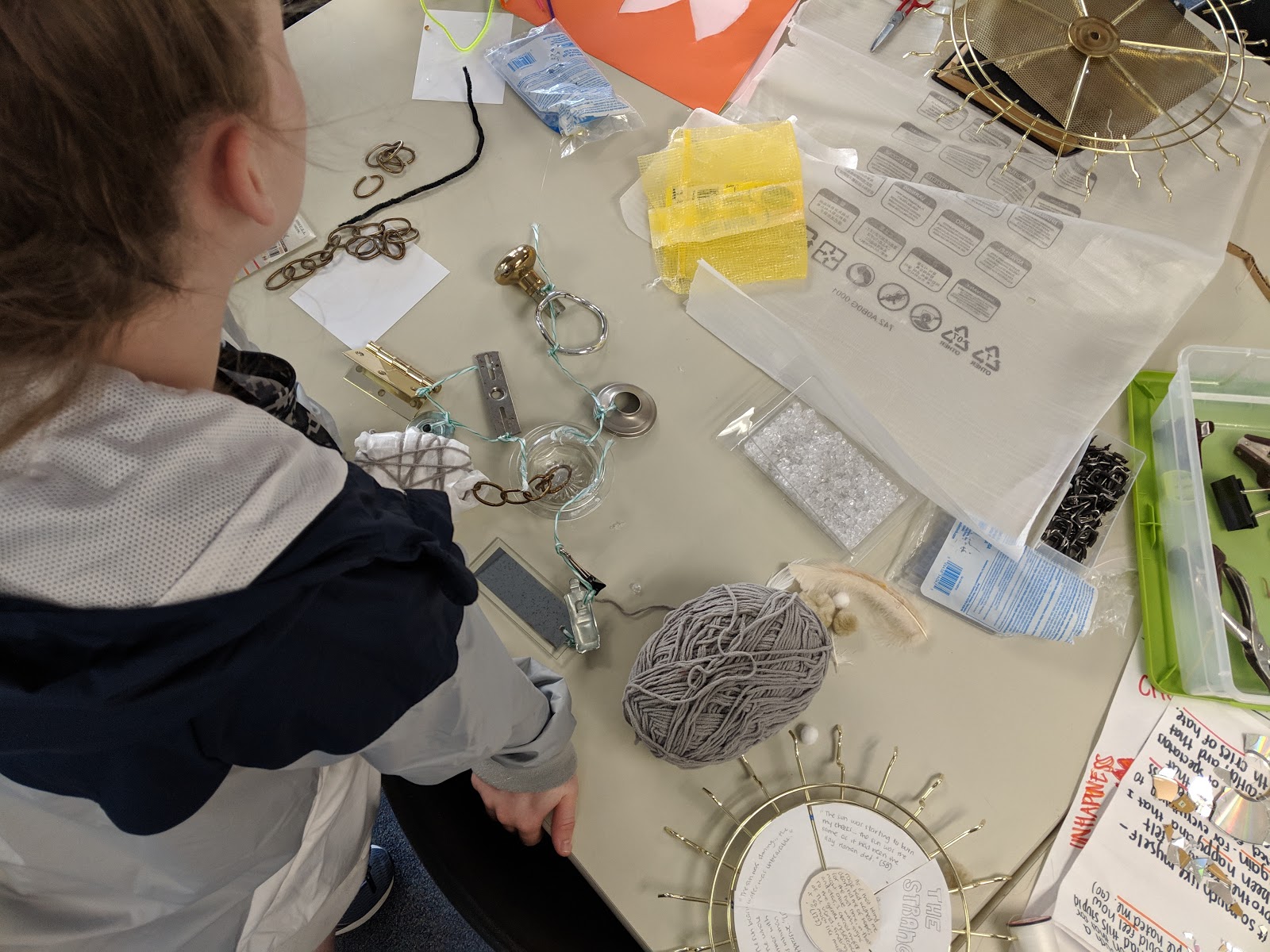
The challenge was for students to create a three dimensional representation of the sensory experience of the image in the text. They were not building dioramas or models of suns (or any other image). They were providing the viewer of their construction with the same visceral or sensory experience that Camus created and Meursault experienced in the text. And they began the creation process by framing their image in a question, such as: what does the door look like that is the gateway to Meursault's unhappiness?

When their work was finished, the students wrote gallery cards in which they explained the construction choices they made and how their renderings connected to the text.

I was careful not to use the words artistic or creative when working with them. While their processes and products can be considered both of those things, many students -- all of whom are very accustomed to writing literary analysis essays -- lamented their lack of creativity or artistic talent. Over and over I explained that they were constructing a prototype of an idea, much like Camus wrote drafts of the text, and that as they watched people interact with and react to their construction they could reconsider and improve upon the impact it had on its audience.

In fact, I pointed out, very few (if any) of the sensory experiences evoked by the text imagery were pleasant so if someone looks at what you are making and says, "Oh, that's so pretty" (or something to that effect) you probably aren't actually making the text, you are making your idea of the image. Anyone can turn a pompom into a sun; it takes a creative constructor and communicator to build the sun that permits someone to take a life. Most of us, if pressed, could turn toothpicks and Popsicle sticks into a staircase. How might you render the dark, dank stairwell descending into depravity?

See what I mean? Not pretty.

Yet, so valuable. When a student started making I left him/her/them alone until they looked stuck, asked for help, or seemed to be assembling without purpose. Then I started asking questions like why that color? why six spokes? why can I see inside? As students began explaining their choices they were flooded with ideas and recommitted to their work. When some students couldn't explain their choices, I directed them back to the questioning phase reminding them that what they made was an extension of and still connected to the text. That the question was the bridge between the text and the construction. For students who were creating something personal and pleasing I asked where Meursault was in their construction.

Hot glue guns are fun. Upcycling, recycling, repurposing for fun isn't necessarily hard. Building a sensory experience is. Some students lamented that they couldn't "just write a paper" which told me two things: one, they were really trying to build something with meaning, and two, they were really used to writing papers and this challenge was a good one for them to confront.

Here are the students at work:


Friday, May 18, 2018

Making Converts

For several weeks it felt like spring would never happen. It was cold and dreary. We were having snow days in April and the year kept getting longer. Finally, the sun came out, the air warmed, and it started to feel like the year was winding down. There was prom. Now the seniors are leaving for internship. The exam schedule has been published. And that is either coinciding with or maybe causing a shift in the thinking of a few of my colleagues. This is what I am hearing:

- They need to do project.

- The seniors should do something fun before they go.

- They are checking out; I need a way to hook them back in.

And, then, a couple of them asked: can you explain that makerspace to me again?

Of course! YES! I would love to! And then I put some pipe cleaners in their hand while we talk.

This week I have been working with a Social Studies teacher in two of her classes and with an English teacher colleague in two of her classes - both pairs of classes are a mixture of juniors and seniors.

Today was the project due date for the Social Studies classes and here is how the teacher described what happened:

"We had a board game day today and the class broke into groups to play each of the games. And I did what you said, I told everyone they couldn't play their own game because one test of the effectiveness of the game was whether or not someone could follow the directions and understand how to play without them there to explain it all. And they didn't want to leave their games! They were so proud of them, they wanted to be sure that everyone else really appreciated and understood them." And then she added, "Remember that kid I told you about who still owes me so much work from last quarter? The one who never does any of the assignments? He made the coolest board game! He refused to leave his game. Flat out refused. And I let him stay so he could have that pride in what he had done."


That's when I told her a story about a group of girls in her class who had worked together on their project. They did all of their work in the classroom until the very last project work day. On that day my colleague, their teacher, was out. To get away from the sub, the students decided to work in The Garage (our makerspace). When they arrived they asked me, "what are we supposed to do?" I put pipe cleaners in their hands and replied "Well, what do you need?" They said they needed a spinner and playing pieces. So I asked: "Well, what should the pieces look like or represent?"

You know where this is going... those pipe cleaners were quickly bent into a prototype of the animal shapes they needed. I directed them to our bins of supplies and recyclables and they looked at me with open mouths; "Has this been here all year?!" they asked. I nodded. They grabbed each others arms and exclaimed: "Can we come here during a free and just make stuff?" I told them, "Of, course!" To which they responded: "This makes me so happy!"

I couldn't join their class for project sharing day because my English colleague brought her classes to The Garage for their first full-period making session. This project is the culmination of their study of Jeanette Walls, The Glass Castle. Last week, I introduced the project to them with this discussion of unattainable dreams, symbols, and the relationship between artists and their audience.

Less than a minute into class she leaned over and said, "Oh! This is amazing. I am so glad you are getting pictures of this! Should I take some, too?" Here is what was so amazing. Complete and total engagement in selecting the only required element of their project: a piece of glass. The students were sharing and comparing. Discussing the merits of clear vs. translucent glass. Shape and texture were important, too. Then I delivered a 3-minute orientation to the space, listing a variety of materials from pom poms to old "steampunk" hardware and ended with: "If you are thinking about a material you can't find, just ask." That's it. They were off!

Once they had been planning, designing, and experimenting for about 10 minutes, I approached a small
group who were intently debating the best way to attach two parts of a project. I asked what problem they were trying to solve and they showed me and launched into an explanation of the merits of the different solutions they were entertaining. Their English teacher approached and looked over my shoulder, and the students entirely shifted gears. "Don't worry, don't worry!" they said. "It's going to be good. You're gonna like it. There is a good reason for what we are doing. I promise: we are working."

My colleague pulled me away from them and asked, "Did you see that? Did you see what just happened? As soon as I walked over it became all about the grade, about reassuring me they were making something I would like. This is entirely different than when you come to our classroom. Our roles here are totally different. But they are thinking so intently and in such different ways. I mean, look at them! Some of these kids checked out weeks ago and now they are so engaged I can't even talk to them!"


The best observation came next:

"You need to come to one of our department meetings at the very beginning of the year next year and tell everyone about this. And then people like me will back you up. I know you told us about it at a meeting earlier this year, but we didn't get it. But now there are more of us to help people get it."

I will gratefully accept an opportunity to discuss making with them. And, next time, I will bring pipe cleaners!

Thursday, April 19, 2018

How might we... engage in Gatsby?

I am preparing to embark on a new collaborations with a colleague in the English department. It will be a unit-long project-based exercise so we will work together for about four weeks. I have tested the methodology on a small scale with a social studies teacher while helping to introduce a project-based assessment. While extended collaboration between a library media specialist and a discipline teacher is not uncommon, in my experience it generally happens around research units, so it is exciting to be co-facilitating in a new capacity!

In English
For the English unit, the class will be reading The Great Gatsby. The teacher's literary priorities are for the students to explore:
  • private vs. public theme
  • unreliability of the narrator
  • the malleable nature of memory
  • conscious and unconscious creation of self
Because this is not an inter- or trans-disciplinary curriculum or course, the English teacher as invited a history teacher to direct a couple of lessons at the beginning of the unit to contextualize Fitzgerald and the novel.

With these teachers serving as the discipline or content experts, my role is to guide the students through the creation of a project in which they explore the intersection of the literary themes and history. In order to maximize student ownership of the project design, I am returning to the lessons of the Innovator Academy and introducing the students to  the "How might me...?" questions. This stem is the gateway to diverse and powerful ways of understanding and beginning to solve a problem. By viewing the communication of their insights as a problem to be solved, "how might we..." will push students to harness their strengths and talents as creators in order to tap into nuances of the text and its resonance across decades.

For example, there are so many possibilities for what a student could do in response to this question: "How might we expose the layers of self that Jay Gatz created?" This question could be asked in other ways such as, "How might we explain Jay Gatz’s compulsion to be someone else?" A student who chooses to turn his/her focus to the narration of the novel could ask: "How might we compensate for Nick’s unreliability as a narrator?" Students will have agency over the question that guides their inquiry and determines what they create.

Also important is that the question can be completed in so many ways for students to access any of the literary elements and rhetorical devices they will be studying. Consider these uses of "how might we..."
  • Amp up the good (Doesn’t Nick grow?)
  • Remove the bad (We are onto Nick, so it is OK)
  • Question assumptions (Who says he is unreliable?)
  • Use unexpected resources (Are there other characters offering their versions of events?)
  • Challenge the status quo (It’s not the narrator’s job to relate to us)
  • Address PoV (Would Jordan tell the story better? Which character barely speaks and how can we give him/her voice?)
  • Go after adjectives (like “unreliable;” maybe he is uninformed or naive?)
  • Play against the challenge (If Fitzgerald wanted us to compensate for Nick, he would have written a different narrator)
  • Explore opposites (How might we remove the need for a narrator?)
  • Employ analogies (Nick, as a narrator, is like, chocolate as a…)

Once each student chooses the How Might We problem s/he wants to pursue, we will provide brainstorming tools to help them explore the possible solutions. (Crazy 8’s is one example of a tool or protocol).

Students will partner with critical friends in the class and discuss the merits of each idea and choose the one they will prototype and ultimately create.

In Social Studies
With the students in 9th grade World History, I introduced "How might we..." in a very different context. This is a class of 55 students divided into two sections. Each section must work as a unit for this project. Here are the questions the teacher has outlined for the students:
  • What is progress?  (craft a definition of what progress means for a society)
  • Examine the 14th-17th century in Western Europe and determine if (and if so how) the Renaissance and Protestant Reformation were a time of progress.
  • Conclusion:  Why does this matter?  What drives progress?  What keeps society from progressing, perfection of institutions or individual challenge of institutions?

The only other criteria is that they may not deliver an oral presentation. Each section must devise a way to convince the other section of their thesis without a formal debate or stand-and-deliver talk. That's where "How might we..." comes in.

I guided the students through an exercise to determine the best means of conveying their argument and evidence beginning with: how might we best convey our findings and conclusion without talking directly to the other group? Exploring this prompt required them to consider the scope of their findings and the various media they contain. It also necessitated understanding their audience and the mode or modes of delivery most likely to sustain their interest and be accessible to all of them.

Let's say that one group decided what is most important is for the other group hear the music, public debates, and other sounds happening during these centuries. They could produce a podcast or radio show. They could create a music video by quoting and re-contextualizing music and words of the era. Lots of possibilities if they start to think aurally.

Maybe the other group decided what is important is touch. You have to hold the artifacts in your hand to understand how they worked and why they matter. They will be very busy in The Garage (our makerspace) then!

Sight can be the students' default mode. In this instance maybe they will decide to curate a museum exhibit using Google Arts and Culture. Or create a virtual reality simulation using a our 360 degree camera to take a photo or video of a scene or scenes they create. Or a living scavenger hunt where they find class members dressed in period costumes. Given how image rich these centuries were, yet another possibility is that they might build a mosaic using many images to combine and form a dominant image which they can then annotate.

What's really exciting to me, is that these students are owning the means by which they explore the content and by which they convey their learning. When their creative thinking and varied skill sets and experiences combine for this exercise I am confident the results will be amazing.

More, soon...

Tuesday, January 16, 2018

The Tempest, Character Boxes, and Students in the Garage

The Shakespeare class has returned to the Garage to begin assembling their character boxes as the final assessment for their study of The Tempest. The students were given three options which I wrote about in a previous post. All of them chose the independent box project. Here are the guiding questions and criteria:

What kind of box or container best fits this character? (could be a steamer trunk, magical cabinet, barrel, burlap sack, coffin, etc.) Why? And how will you show this?

Does this box ground this character to a place or allow (force?) this character to move? Why? And how will you show this?
What does this character:
    • Hope?
    • Fear?
    • Believe?
    • Desire?
    • Wonder?
    • Deny?
    • Aspire?
    • Want?
    • Plan?
As a result of the attributes above, what would s/he put in the box? Find or make those things to add to your box, at least one item per attribute. Justify each selection with an excerpt from the play.

As a result of the attributes above, what else would be in the box whether or not s/he wants it there? Add it to the box and justify it with an excerpt from the play.

Design the outside of the box to resemble how the world sees the character; design the inside of the box to represent how the character understands him/herself.

Some students found the container or box they want to use and are letting the form of the box dictate how their other choices evolve. Other students are building their box out of a particular material because of what the material will say about their chosen character. Still others are beginning with the form or shape they want their box to be and then coating, layering, and transforming the shapes of the inside and outside of the form to become the appropriate container for their character.

Similarly some students are starting with the outside of the box and working their way to the inside and then to the contents. Other students are starting with the contents and developing a box that will be able to contain them.

Here is how one student described her thought process:


This kinesthetic, multimedia project has gotten their creative juices flowing and the students are requesting lots of materials. Some (but not all) of the materials or items I can bring to them from my garage at home. I sent an email to the faculty and staff which said:

WHS Learning Community,

The Garage (formerly the LLC makerspace) is in need of some materials for student projects that are currently underway. If you happen to have, and are about to discard:
    • crates from clementines or other produce,
    • drawstring (or other style) sacks of any material,
    • perler beads, or
    • fake flora: flowers, leaves, etc.
students are requesting these materials for a project they are doing.

We will gratefully accept donations of any materials you are looking to dispose that can be up-cycled, recycled, and re-purposed in student projects. Scraps of fabric, old baskets and crates, random hardware, etc. If you aren't sure if we can use it, shoot me a quick email -- the answer will probably be YES!

Thank you!

Many people have responded offering all sorts of materials from the items on the list to all sorts of other materials. We will soon be flush with new resources! And many people are offering to deliver their donations which will increase traffic through the space and hopefully result in more teachers bringing their classes to work in the Garage!

Later this week, the class will return to the LLC and present their boxes to each other. When the teacher asked if they would rather conduct presentations in the classroom or in the library, they unanimously chose the library!

Thursday, January 4, 2018

Shakespeare in the Garage

Students enrolled in the English department elective, Shakespeare, will be the first class to work in The Garage (our re-branded makerspace). Before the winter break the class visited for an orientation to the space and their project. Next week they will begin creation now that they have had time for project ideas to gestate and to collect materials they may want to use or contribute to their classmates.

I consulted with the classroom teacher to understand his learning objectives, assessment needs, and concerns about embarking on this type of project before designing options for the students. Primarily the teacher was concerned that the level of rigor to which he was accustomed when he assigned papers to students be maintained in this approach. In addition, if there was to be a collaborative component to the project, he wanted to be sure that each student contributed fairly and purposefully to the group product.

In the past, the teacher had consulted the resources and suggestions from the Folger Library when planning for this Shakespeare class so when I developed three options for the students, I began by adapting an idea he had seen there knowing that he recognizes their resource credibility. Here are the ideas I proposed:

Idea 1: Character in a Box (individual project)

What kind of box or container best fits this character? (could be a steamer trunk, magical cabinet, barrel, burlap sack, coffin, etc.) Why? And how will you show this?

Does this box ground this character to a place or allow (force?) this character to move? Why? And how will you show this?
What does this character:
  • Hope?
  • Fear?
  • Believe?
  • Desire?
  • Wonder?
  • Deny?
  • Aspire?
  • Want?
  • Plan?
As a result of the attributes above, what would s/he put in the box? Find or make those things to add to your box, at least one item per attribute. Justify each selection with an excerpt from the play.

As a result of the attributes above, what else would be in the box whether or not s/he wants it there? Add it to the box and justify it with an excerpt from the play.

Design the outside of the box to resemble how the world sees the character; design the inside of the box to represent how the character understands him/herself.

Idea 2: Wandering Journal (group project with individual components)

You will work in a group of four; each student assumes the role of one of the main characters in the play: Prospero, Caliban, Ariel, or Antonio.

Create an entry in your journal, in character, in response to the following words by Miranda:

“Oh wonder!
How many goodly creatures are there here!
How beauteous mankind is!  O, brave, new world
That has such people in ‘t! (5.1.215-218)

Then, trade journals with another group member, and, still in character, create a journal entry in response to the original one.

You will continue to trade journals until your original journal is returned to you.

Identify journaling techniques that will work for each play element to be explored; each group member must use at least the techniques in bold and at least two additional techniques:
  • Using the actual text page(s) as canvas
  • Using the same passage (Act V, Scene 1) from the text for a found poem
  • Image creation and annotation with lines from the play
  • Found image collage and annotation with lines from the play
  • Color vs. monochromatic - purposefully use color as a symbol or motif
  • Storyboard: segments vs. whole page
  • Multiple drawings of same concept or object (POV) incorporating color and media as it pertains to each POV
  • Media/material variation
This cycle will be repeated with a new prompt of the group’s choice or a new set of characters.  Your complete journal will have a total of eight character entries (two from each student in the group), artwork, and additional creative writing elements.

After you review the different entries, you will then make an entry in your own voice (not in character) in which you respond to and comment on what you learned from the collection of entries. 

You might consider:
  • Origins of conflict and obstacles to resolution
  • Gaps in understanding rooted in differing cultures
  • What it means to be, or to consider someone else to be, the “other”
  • At least one way in which these themes of the play resonate in contemporary society
Also, you will design an appropriate cover for your journal. 

Students must write a Shakespearean sonnet as a closing exercise and document the sonnet in their journal.  Use this checklist. (provided by the classroom teacher)

Idea 3: Personal Journal (individual project)

Students work independently to create a journal that explores all of these elements of the play:
  • Setting
  • Characterization
  • Culture and conflict
  • Family
  • Intersection of tragedy and comedy
As well as these themes:
  • Origins of conflict and obstacles to resolution
  • Gaps in understanding rooted in differing cultures
  • What it means to be, or to consider someone else to be, the “other”
  • At least one way in which these themes of the play resonate in contemporary society
Identify journaling techniques that will work for each play element to be explored; you must use the techniques indicated in bold and at least two additional techniques:
  • Using the actual text page(s) as canvas
  • Using a text passage for a found poem
  • Image creation and annotation with lines from the play
  • Found image collage and annotation with lines from the play
  • Color vs. monochromatic - purposefully use color as a symbol or motif
  • Storyboard: segments vs. whole page
  • Multiple drawings of same concept or object (POV) incorporating color and media as it pertains to each POV
  • Media/material variation
Design a cover for your journal and create at least eight, full-page entries in your journal, at least one entry for each element of the play and at least one for each theme. Each page should incorporate relevant lines from the play.

Students must write a Shakespearean sonnet as a closing exercise and document the sonnet in their journal. Use this checklist. (provided by the classroom teacher)

These materials are available in the Garage for students to use:

3D printer
Basic circuitry, LED lights, sound cards
Markers
Colored pencils
Chalk pastel
Oil pastel
Poster & watercolor paints
Duct tape, various patterns & colors
Glue: sticks, hot, tacky
Felt
Foil
Embroidery floss
Ribbon, Fabric & Yarn: various widths, lengths, patterns & colors
Buttons
Sewing supplies
Construction paper
Wrapping paper
Cardboard tubes, varying sizes
Recycled: plastic containers, magazines, plastic netting, 3D printer shapes
LED finger lights
Mason and other shaped jars
Sequins
Pom Poms
Feathers
Popsicle sticks
Pipe cleaners
Bottle caps
Beads
Clothes Pins

I developed this rubric for the students to use in planning their projects and for assessing their final products. To learn how the rubric works, students practiced by applying the rubric to the work of Lynda Barry which is available to them in print form in the Library Learning Commons collection as well as personal copies I let them borrow.

MULTIMEDIA PRESENTATION RUBRIC

The Way You Do the Things You Do *
The Temptations
Knockin' on Heaven's Door
Take your Pick
Unchained Melody
The Righteous Brothers
What's Goin On?
Marvin Gaye
General
Appearance
&
Aesthetics
Strong aesthetic appeal, not cluttered, graphics enhance content;

image selection is appropriate; makes you want to continue interacting;

enhancements enrich the viewing and learning experience and significantly contribute to conveying the content and meaning, content-relevant visuals establish a clear visual pattern that aids audience understanding
Multimedia elements adequately contribute to conveying the content and meaning;

most graphics used appropriately to enrich the experience; although purpose may not be readily evident;

main points are evident and expanded through presentation; good, relevant visuals
Lacking attention to aesthetic design.

Graphics are random or insufficient and do not enhance content;

too much text, needs to be condensed
Graphics interfere with or distract from content and communication of ideas;

inappropriate or no use images; an essay on a poster
Critical
Thinking
&
Content
Mastery
The presentation of ideas is thoughtful, insightful, clear and focused. You approach the topic from an unusual perspective, use your unique experiences or view of the world as a basis for communicating; you make interesting connections between ideas. It is implicit that this exploration matters.

Explores the complexity of the issues; in-depth analysis; confrontation and discussion of conflicting information, motivations and ideas; critical thought & research evident; interprets principles in accurate and insightful ways.

Thoroughly researched; all points substantiated by evidence; no assumptions; sophisticated understanding of details, nuances and subtleties of the content; sufficient information to make the presentation worth reading or viewing; information is conveyed; content effectively achieves its intended purpose; historical information is accurate and relevant.

Makes frequent, meaningful and rich cross-discipline and/or real-life connections
You attempt to develop all ideas; although some ideas may be developed more thoroughly and specifically than others; the overall development reflects some depth of thought, enabling the viewer to generally understand and appreciate your ideas.

Analysis accurate but lacking depth of understanding; may not demonstrate clear understanding of audience motivation; may lack thoroughness in addressing purpose.

Considerable evidence contributes to message development but lacks depth; assumptions cloud facts, some ideas are ambiguous.

Makes relevant cross-discipline and real-life connections
Limited by superficial generalizations; unclear or simplistic; may be simply an account of a single incident instead of articulating a purpose; therefore the viewer cannot sustain interest in the ideas

More descriptive than analytic; relies on summary of information and events rather than application of information to audience opinion; makes errors in interpreting research; ineffectively synthesizes the information.

Exhibits only sketchy or insufficient evidence; may have errors; some understanding of details, nuances and subtleties of the content; most subject knowledge is literal and does not enhance message development.

Attempts some cross-discipline and real-life connections that demonstrate partial understanding
Confusing and hard to follow; disorganized; develops no connections among ideas; statements are convoluted and viewer is left questioning the work itself and not the ideas presented in the work

Inadequate or inaccurate understanding of the information, events or audience; attempts at analysis or insight are confused or inappropriate; major errors in understanding.

Almost no use of evidence; attempts are confused or inappropriate; major errors; complete misunderstanding or no effort to understand the details, nuances and subtleties of the content.

Learns primarily without cross-discipline or real-life connections
Presentation

Shows sophisticated sense of audience; uses language artfully and articulately; meaningfully organizes; uses media/materials effectively
Shows clear sense of audience; uses language effectively; clearly organizes; uses media/materials appropriately
Shows some sense of audience; uses language somewhat effectively; somewhat organized; somewhat appropriate use of media/ materials
Shows little sense of audience; uses language ineffectively; weak organization interferes with meaning; ineffective use of media/materials
* a note on the use of song titles in rubrics
It has long been my practice not to designate point values in rubrics. I use song titles, movie titles or other pop culture references as category headings. I want students to focus on the descriptions of their process, habits of mind, and choices rather than point values. Students frequently debate whether certain category headings are appropriately assigned which is an indicator that they are considering the characteristics and qualities of each section of the rubric.

Monday, December 19, 2016

Using Question Stems to Spark Inquiry

As I am working with students on research exercises I am working to find ways to help them with the development of their research questions. The scope of their research and the means by which they explore what they learn are all products of a well-crafted research question. I am observing that students can ask very narrow questions that begin with "what" and very broad questions that begin with "why." Without prompting, they get stuck here: too narrow or too broad. To help them expand their inquiry strategies I have begun using these question stems to push their thinking:

Which?  This stem helps you to collect information to make an informed choice. For example: Which Twentieth Century president did the most to promote civil rights?

How? When you seek to understand problems and perspectives, weigh options, and propose solutions, try starting your question with this stem. For example: How should we solve the problem of water pollution in Long Island Sound?

What if? Your question can change history! Use the knowledge you have to pose a hypothesis and consider options. For example: What if the Apollo 13 Astronauts had not survived?

Should?  A question can invite self or community examination. Using this stem, you can make a moral or practical decision based on evidence. For example: Should we clone humans?

Why? Understand and explain relationships to get to the essence of a complicated issue. For example: Why do people engage in human trafficking?

I like these stems because students can decide on the purpose of their inquiry and use the stem best suited to that end. They also are versatile and can be used in any discipline. What is really key, is they push students away from bias confirmation, from the tendency to ask questions to which they believe they already know the right answer. By using these stems and asking many questions about the same topic, they are pushed to think critically about the subject of their research and remain open to a range of evidence and perspectives before developing their thesis.

Here are examples of the stems being used all about the Civil War:

  • Which Civil War general was the best military strategist?
  • How did King Cotton affect the Confederacy’s waging of war?
  • What if General Lee had better intelligence at Gettysburg?
  • Should Confederate symbols be used in official state flags and logos today?
  • Why did Great Britain favor the South during the Civil War?

And here are literary examples focused on Shakespeare's plays:

  • Which of the characters in Henry IV has the most relevance for today’s politicians?
  • How does Hal’s ascension to the throne affect perceptions of his father’s coup?
  • What if Brutus had made the final funeral oration in Julius Caesar?
  • Should Hamlet have minded his own business?
  • Why does Shakespeare use so many references to the natural and unnatural in Macbeth?

I have used these this year with grade 11 students researching the relationship between socioeconomic class and opportunity in modern America. These stems helped the students focus their topics under the umbrella of the unit essential question.

Today I will use them with grade 10 students. Their essential question is "What should be America's response to the current refugee crisis?" Imagine the research possibilities with each of these stems: Which country has a fair, enforceable policy in this current refugee crisis? How does US response to Syrian refugees compare with US response to Holocaust / Bosnia / Vietnam refugees? What if the US reinstated quotas like those of the 1920s? Should the UN establish and monitor camps for the refugees? Why did the French respond to the Calais Jungle as they did? Using these question stems, the students can focus their research on the aspect of this issue that is most interesting to them, and the teacher can engage with the students about content that the student has chosen so the curricular experience is personalized. Ultimately the students will be writing Op-Ed pieces and they range of issues and perspectives considered will read to rich classroom discussion and mean the teacher is not reading twenty five identical papers. A win-win exercise!

Saturday, November 19, 2016

Inquiry: Framing Research Questions & the QFT

Two new teachers approached us and began the conversation by saying: "We remembered how you
said that you are willing to help with anything we are doing in class."

"YES!" we said in response. "That is what we do! How can we help?"

So we are preparing to work with four classes of juniors who are embarking on a research paper. This paper is a common assessment for the junior English classes so this is a pilot for an approach we could replicate in other classes. We were asked to help with narrowing topics, developing research questions, locating and annotating sources, accurate citations,... this is what we do!

The course Essential Question that will guide the focus of the students' research is: How does social class impact opportunity in modern American society? The students have already been asked to identify subtopics that can be explored in the context of this question. They have identified: Education, Immigration, Marriage, Health Care, and Ethnicity

We decided that the QFT (Question Formulation Technique) outlined in Make Just One Change by the Right Question Institute was the perfect avenue for both topic focusing and question refinement. During our Professional Learning day at the beginning of the month one of the workshops faculty members could attend was about inquiry and how to use the QFT so this is a perfect application of that learning!

We will remind the students that research requires lots of questions, all different types of questions. Essentially, all research (regardless of the form of the final product) is the process of asking questions, finding answers, asking new questions, finding new answers, and so on until you reach a satisfying, defensible, unique understanding.

Here are the steps they will take:

1. Start by exploring your Q-Focus (more on this in a bit)

  • Ask as many questions as you can
  • Don’t stop to discuss or judge or answer
  • Write each question as it was stated
  • Change any statements into questions

2. Now improve your questions

  • Sort your Q’s into two categories:
    closed-ended
    open-ended
  • Rewrite a closed question to be open-ended. 
  • Then rewrite an open question to be closed.

3. Prioritize

  • Select your top THREE questions that your group thinks best explore the topic of your research.
  • Share these questions with the class

The key to the whole process is a well-selected Qfocus. For each of the sub-topics identified by the classes, we are brainstorming and discussing the most appropriate Qfocus. We need things that the students can understand, that will challenge their thinking and assumptions, that will inspire divergent thinking. Here is what we are considering:

  • Education: PSAT scores from an anonymous student
  • Immigration: a foreign birth certificate, a green card
  • Marriage: we are still discussing this one (please share ideas if you have any!)
  • Health Care: data on health care access disparity
  • Ethnicity: this cartoon about white privilege or Peggy McIntosh's checklist

By working through the QFT protocol, students will be able to narrow the focus of their research, determine their guiding research question, and identify the sub-questions it will be necessary for them to answer in order to develop a thesis about their main question.

Next steps: working with the students to find, vet, and annotate sources! Stay tuned!