Thursday, August 1, 2019

Rethinking back-to-school with help from student activists

The twitterverse and other edu social media platforms are buzzing with back-to-school ideas. Last year, prompted by my daughter packing for her first year at university, I wrote my back-to-school reflection about how much has changed about learning since I packed for my first collegiate year. And I wondered how her professors and her university (Clark University: Challenge Convention, Change our World #rollcougs!) prepared to engage in her learning journey.

This year, I am prompted by her to reflect again. My now college-aged daughter just returned home from a few days of leadership and advocacy training at the March for Our Lives Summit. She was bursting with energy and stories that filled 90 minutes of conversation on the ride from the airport and rendered me simultaneously brimming with pride and speechless.

My takeaway as I listened to her describe and process her experience:

What students do for themselves
when they organize for a purpose
is a call to action for educators.

At the Summit, they explored identity: the varying and fluid aspects of their life experiences that inform their world view.

They engaged in a deep discussion of privilege. They wrestled with types of privilege and our responsibility to recognize the privilege we each have and use it to lift others up.

They learned how to tell their individual stories to build relationships with diverse people. And they learned how to affirm each other in both disagreement and agreement.

They practiced building a Yes, and... mindset.

They examined teams and collaboration to understand how people work well together: each member contributing their talents, identifying group needs, and filling them with more talent.

They engaged in current events. They strive to be informed and purposeful in their actions.

All of this they did for themselves and each other, together. And it makes we wonder, as the educators who will welcome them back to our schools and classrooms in the coming weeks, how are we preparing to challenge, nurture, and empower them? How will we meet them where they are and help them grow toward their passions? And, the same question I asked last year: how will we contribute to their development as empathetic, global citizens?

Feel free to share your ideas, plans, and suggestions in the comments. Let's learn from each other.

Wednesday, May 8, 2019

Making Motifs and Sense Imagery

Artist and educator, Tim Rollins,who passed away in 2017, was the founder of K.O.S -- Kids of Survival -- now called Studio K.O.S. Tim's work with students in the South Bronx blended art making with the reading and deconstructing of classic literature. The work of K.O.S. is celebrated by galleries and museums globally.

In 2003 I had the distinct privilege of partnering with Tim for a full day workshop with my students. To this day, I continue to channel what I learned from Tim about making complex texts accessible to all students through visual translation and interpretation. Most recently, I partnered with an English teacher colleague to work with her students making sense imagery to explore Camus' The Stranger.

Her goal was for the students to analyze the author's language and purpose in creating sensory rich images. She planned to start the project by asking the students to crowd-source a Google Doc with imagery quotations from the text. However, she was concerned about how productive and purposeful they would be given that on a previous occasion when she asked them to contribute to a Google Doc in a similar way, they were less than ideally productive and added silly images and other distracting elements to the Doc. I suggested a Google Form as an alternative. The students were each assigned a chapter to examine; they entered the images they identified and the corresponding text passages and page numbers into the Form. Then the teacher shared the resulting Google Sheet with the class and they had an comprehensive, searchable, sort-able collection of images and quotations from which to select for their project.


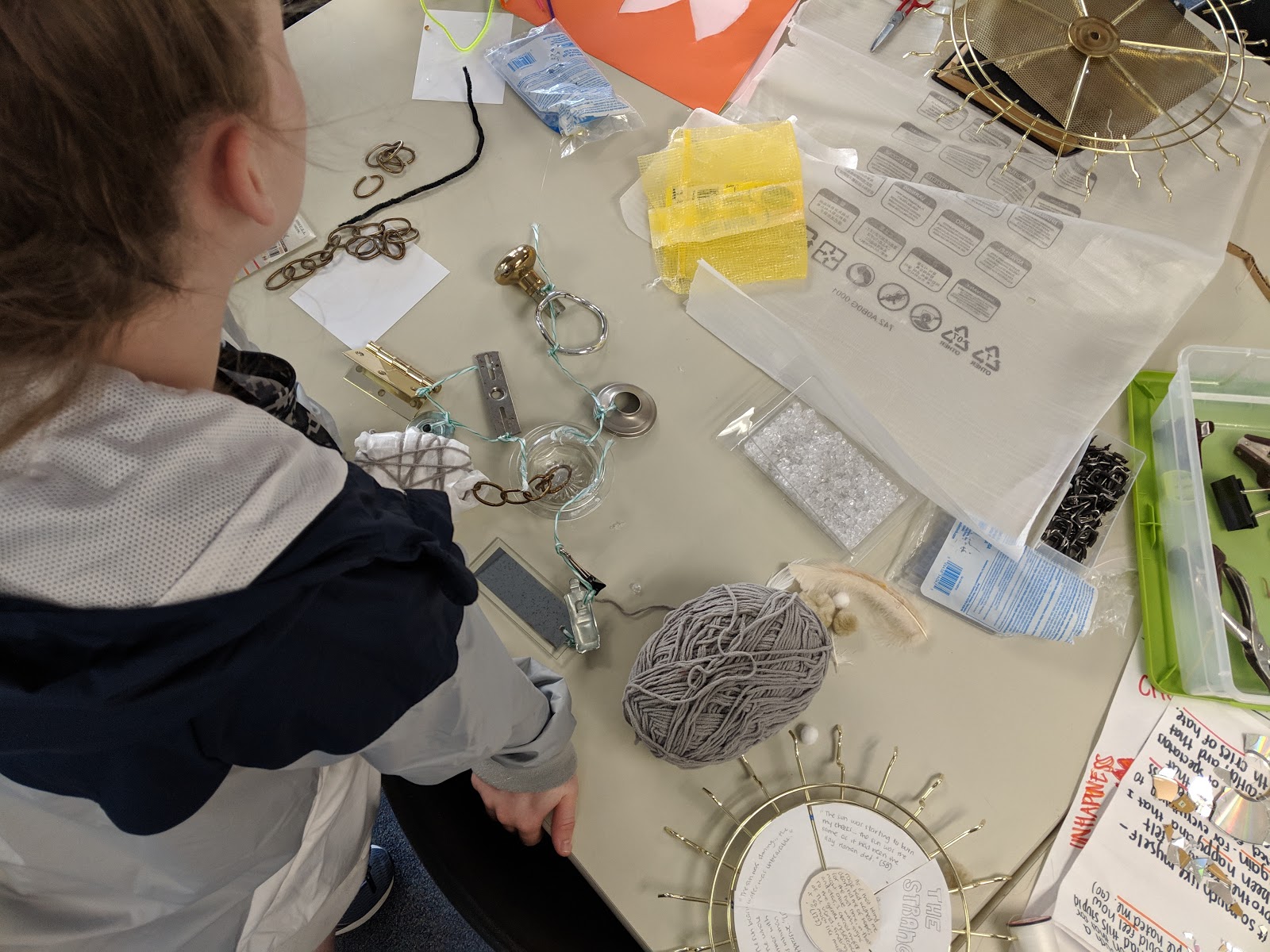
At this point, I introduced the "making" exercise with these slides. I began with an homage to Tim and K.O.S. as the inspiration for the project and then gave the students step-by-step directions to help them transition their thinking from words to images.


The challenge was for students to create a three dimensional representation of the sensory experience of the image in the text. They were not building dioramas or models of suns (or any other image). They were providing the viewer of their construction with the same visceral or sensory experience that Camus created and Meursault experienced in the text. And they began the creation process by framing their image in a question, such as: what does the door look like that is the gateway to Meursault's unhappiness?

When their work was finished, the students wrote gallery cards in which they explained the construction choices they made and how their renderings connected to the text.

I was careful not to use the words artistic or creative when working with them. While their processes and products can be considered both of those things, many students -- all of whom are very accustomed to writing literary analysis essays -- lamented their lack of creativity or artistic talent. Over and over I explained that they were constructing a prototype of an idea, much like Camus wrote drafts of the text, and that as they watched people interact with and react to their construction they could reconsider and improve upon the impact it had on its audience.

In fact, I pointed out, very few (if any) of the sensory experiences evoked by the text imagery were pleasant so if someone looks at what you are making and says, "Oh, that's so pretty" (or something to that effect) you probably aren't actually making the text, you are making your idea of the image. Anyone can turn a pompom into a sun; it takes a creative constructor and communicator to build the sun that permits someone to take a life. Most of us, if pressed, could turn toothpicks and Popsicle sticks into a staircase. How might you render the dark, dank stairwell descending into depravity?

See what I mean? Not pretty.

Yet, so valuable. When a student started making I left him/her/them alone until they looked stuck, asked for help, or seemed to be assembling without purpose. Then I started asking questions like why that color? why six spokes? why can I see inside? As students began explaining their choices they were flooded with ideas and recommitted to their work. When some students couldn't explain their choices, I directed them back to the questioning phase reminding them that what they made was an extension of and still connected to the text. That the question was the bridge between the text and the construction. For students who were creating something personal and pleasing I asked where Meursault was in their construction.

Hot glue guns are fun. Upcycling, recycling, repurposing for fun isn't necessarily hard. Building a sensory experience is. Some students lamented that they couldn't "just write a paper" which told me two things: one, they were really trying to build something with meaning, and two, they were really used to writing papers and this challenge was a good one for them to confront.

Here are the students at work: