Showing posts with label independent reading. Show all posts

Tuesday, February 14, 2017

Overcoming Impediments to Student Close Reading

I was talking with a colleague whose students are engaged in a lengthy research project inspired by Jared Diamond's Collapse. Inspired by this mentor text, students research, create infographics, present to their peers and write about the health and future prospects of our civilization. The problem my colleague was lamenting was that students were, at best, skimming the mentor text. At worst, they were randomly choosing excerpts to share before jumping ahead to the creation portions of the project. Needless to say, without a close reading of Diamond, the final presentations will be superficial and generic. So, my colleague's question was two-fold: 1) why aren't they reading? 2) how can I get them to read?

Here are my recommendations on students and close reading.
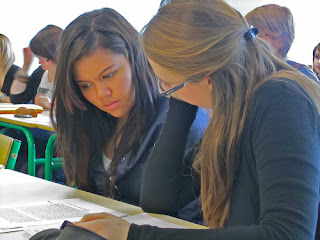
For this project in particular I suggested a re-structuring of the student groupings and tasks. As the project is designed now, students work in pairs with each pair presenting the reading about one of twelve different societies. Instead, I suggested, focus only on six civilizations and have four students assigned to a society with two of them responsible for presenting the reading about that society to the class and the other two responsible for critiquing the presentation based on their reading of the same text. They can do this in a fishbowl so the rest of the class is learning the content and how to be critical friends.

Furthermore, I surmised that one reason students weren't reading was because they were given, all at once, the entire scope of the exercise from the initial reading assignment to the final stage that was still weeks away. Students were jumping to the product and skipping the process because they needed more scaffolding. I suggested putting them in groups and giving them the reading assignment as a discrete exercise. Keep their focus in the moment.

Even if the assignment was scaffolded, Diamond's texts have a lexile measure of about 1400. Students need specific support to unpack the text. To that end, I had other suggestions:

Students could keep a dialectical (double-entry) notebook while reading. There are lots of models of these notebooks. Some are basic and have one column designated for student summary of an aspect of the text and the other for student questions based on those summaries. Others give different column headings like "Point of View" or "Comparison" which prompt students to think critically and analytically about what they are reading.

In non-fiction lit circles, students are assigned a focus while reading. They then meet in small groups to share the conclusions they reached given their individual focus and discuss the importance of the reading evidence and insights. Reading roles can be adapted to different texts and types of media. Here are some suggested ones:

  • Questioner: what would you ask the people in the passage if you could? Why?
  • Connector: of what are you reminded when you read this passage? (book, movie, tv, current event…) Why?
  • Wonderer: what do you want to know about this situation? Why?
  • Predictor: what do you think the outcome of the conflict will be? Explain.
  • Passage Picker: select the passage you think is key to understanding the text. Explain its importance.
Partner annotations is one of my favorite tools when a text can be shared digitally. For example, in a Google Doc, two students can share a text and annotate it by inserting comments. When a student highlights a portion of the text s/he thinks is important s/he can add a comment about why it is important, questions it raises, connections to other issues, etc. Paired students can respond to each other's annotations thereby carrying on a dialogue about the text in the margins.

Some of these strategies can be combined to further enhance student close reading. Consider asking students to keep a dialectical notebook using the reading roles as column headings and then bring that notebook to share in a lit circle discussion!

Happy reading!

Monday, October 17, 2016

Outreach and Relationship Building

Full confession: I was worried about making this jump from the social studies classroom to the library. Let's face it, I had some obstacles to overcome:

  1. I was certified in the Alternative Route to Certification in CT. Would people take my credentials seriously?
  2. I taught social studies for 23 years. Would people trust my respect for and understanding of their non-social studies curricula and pedagogy?
  3. This move is a professional challenge I seek voluntarily. Why do (some) people think I'm burning out and just looking for an easy coast through my last years before retirement?
OK. Question three is EASY to answer. Anyone who thinks I am coasting has no idea what a good library media specialist does, can do, or is willing to do. I aspire to be a great one!

Questions one and two are more complex, but they have a common thread: in this new role, how will I build relationships with people in various departments so they understand, trust, and call upon my capacity as a supportive co-teacher and resource? And, how do I manage this in the shadow of an incredibly accomplished, visionary librarian, with whom they are all acquainted and in whom they all trust?

Well, @mluhtala is not just accomplished and visionary she is collegial, professionally generous, and thoroughly respectful. I am not allowed in her shadow. I stand side-by-side with her, and that speaks volumes about her trust in me which transfers to the rest of our fellow faculty. In fact, when deciding on costumes for a spirit day at school, it was suggested that we be Peter Pan and his shadow. What a cool partner costume idea! And, you have to know that we look alike. A LOT a like. But Michelle said: no, period. We work as equals.


So, I have this tremendous partnership going for me. Now, how do I leave the library, meet colleagues, and encourage them to share their students and class time with me? How do I show -- not just tell them -- them that I can be a valuable partner? How do I advocate for myself and the value of the library in the important work they are doing with their students?

I started with book recommendations.

And my colleagues in the Science department.

The library is on the first floor. The science department is on the third floor. When were our paths ever going to cross? So I sent an email explaining that I wanted our students to know that the teachers read for pleasure. That seeing adults modeling this habit would increase their independent reading. I invited everyone in the department to share with me a favorite book -- fiction or non-fiction -- all they had to do was email me the title and author. When they sent me a recommendation, I took their picture and added it to a Google slide with a picture of the book cover. When I had about seven or eight recommendations compiled, I shared the slides with the department so they could see what the display would look like. Quickly, I had several other teachers send their suggestions.

For the month of October we have featured the science department's favorite books as a display near the entrance of the library. Some people chose what they are currently reading, one teacher recommended her favorite book from high school, another recommended an entire series! And these recommendations are being noticed! Students walk by the display on their way in and out of the library and say things like: "Oh, I have (teacher's name), what's that book?" or in conversation with a friend: "I read that, too! You would really like it."


So, to my science colleagues: thank you, thank you, thank you for helping to get students pleasure reading! And, thank you for entertaining my invitation, even if it felt a little funny to have a new Ms. Luhtala-look-alike take your picture when you weren't sure what I was going to do with it. Thank you for the opportunity to introduce myself to you and chat about books! Thank you for welcoming me to your department meeting and into classes to show students how to access great resources for science research. 

We are teachers and learners. Books are something we all have in common. What a great starting point; I hope this is the beginning of a long and fruitful collaboration!

Next month, we will feature the multi-lingual book recommendations of the World Language department. I sent out their invitation today.

Thursday, October 6, 2016

Independent Reading

Full disclosure: I have always loved reading. When I was little, the Book Fair was one of my favorite school events. Every Christmas list I made was dominated by books. As an adult and a teacher one of my big struggles was the lack of time I had for pleasure reading, relegating those books which accumulated all school year long to the precious weeks of summer when I could divide my time between pleasure reading and curriculum planning for the next school year. Whenever I buy gifts for children it is books. Some of my favorite gifts that I have ever received are books. You get the picture.

Needless to say, I found it heartbreaking when my children reached an age -- or a grade in school -- when reading lost all enjoyment for them. Even summer reading is proscribed. They are told what to read and what to do with and in response to the books. They no longer read for pleasure and I actually worry that they won't rediscover that joy when their agency over reading is restored.

With all that said, as a librarian, I really want students to find the joy in books. Any kind of books: print, ebooks, audio books -- fiction or non-fiction. Just relish the world created by an author and enjoy it just for entertainment or because the story resonates for some reason. In 2000 an ALA report defined independent reading as reflecting "the reader’s personal choice of the material to be read as well as the time and place to read it. Independent reading is done for information or for pleasure. No one assigns it; no one requires a report; no one checks on comprehension." The definition remains sound, the question is how can schools, teachers, librarians, and students make time for this type of reading amidst all of the other required and assessed content reading? And, if more un-assessed reading was done purely for pleasure, wouldn't reading performance assessments improve?

So how do we DO it? Certainly modeling it is important. I wonder: how often during the day do students see the adults around them reading independently? I try to model this by having the books I am reading piled on my desk, and I listen to audiobooks to and from work and usually forget to take my headphones from around my neck during the day. When students ask: are those bone-conducting headphones? I answer with: I was listening to my audio book; do you want to try?

Patty Blount discussing "Some Boys" with #SWVBC

Last evening, I participated in my new school's "Somewhat Virtual Book Club" chat (#SWVBC). We met in the library after hours and ordered for pizza for dinner. At 6PM, we joined a Google Hangout where we met with the students, teachers, and librarians from two other high schools in different states. Just as we were finishing our introductions, the author of the book we were discussing  joined our Hangout. Nothing about this experience was required. Some students still hadn't finished reading the book, but the conversation about the book still mattered to them. Some participants were critical of the book and talking with the author helped them re-frame their perceptions. Still other readers of the book loved it and were thrilled to hear about the author's process and learn why the story and characters evolved as they did. Today, at school, students were still talking about the book, carrying over from last evenings chat.

So much about this experience was so cool! Students could get together and socialize around a common, voluntary reading experience. They could participate from home if they couldn't get a ride to school. Students in different schools, in different states, could meet and interact with each other. Students could ask an author all about their process, their experiences, their words. And students (and teachers) could just listen and take away whatever was meaningful for them. And ultimately, that is what is enjoyable about reading. Each reader takes away personal meaning or challenge or enjoyment. They immerse themselves intellectually, emotionally, imaginatively in a text. What more can we want for our students?

Saturday, September 17, 2016

Book Displays are Working!

This week I watched a student take a book from one of the displays I had set up, take it to the circulation desk, and check it out! Awesome.

She chose a book from the display called: "Coming Soon to a Theater Near You". That display is a popular one. The book she selected is not the only one to be taken from that display this week. So, not only have I been working to supplement that display, I have been working on other ways to put books of interest in the paths of students.

A personal favorite is a display of fiction and non-fiction books the authors of which delivered really interesting TED Talks. I created a Google slide show with cover images and a QR code linked to the TED Talk page, printed it, and hung it on a screen the borders the entrance to the library.

Then, for Open House night, I added some panels to this screen so I could expand the display. When parents came to visit us, I invited them to recommend a favorite book. If they were interested, I took their picture and created another slide show with parent pictures and the covers of their favorite books. As soon as the first two parent book recs were hanging, it gained traction and more parents offered suggestions. I plan to continue to build the display next week by interviewing our parent volunteers and adding their favorite reads to the display.

I hope to curate a list of reading recommendations from each of the departments and feature a different department each month. I plan to start with the science teachers and introduced the idea to them at their department meeting last week. This week, I will visit them in their classes and collect their suggestions. That also gives me a chance to invite them to bring their classes to the library for book talks. Our English teachers promote independent reading by doing this -- I would love to see other departments do that as well. How great to have not just independent, but also interdisciplinary reads!

One of the other cool features of this book display, is that the opposite side behind the book recs faces into the MakerSpace and is a vibrant display of student art created on the paper with which we cover the tables. And to think, these were metal screens slated for disposal at a town facility, that my co-librarian, Michelle, saw and grabbed for our library. How apt that we are making for our MakerSpace!